
Chinese Journal of Sociology ›› 2025, Vol. 45 ›› Issue (6): 208-238.
Previous Articles Next Articles
Peng WANG( ), Antao LI, Xin LIU
Online:2025-11-20
Published:2026-01-20
About author:WANG Peng, Department of Sociology, School of Social Development and Public Policy, Fudan University, E-mail: rmdxwp@163.comSupported by:Peng WANG, Antao LI, Xin LIU. The Returns on Skills in an Era of Technological Change and Multi-Dimensional Segmentation of Chinese Labor Market[J]. Chinese Journal of Sociology, 2025, 45(6): 208-238.
Add to citation manager EndNote|Reference Manager|ProCite|BibTeX|RefWorks

"

"
| 技能小类 | 六分类 | 二分类 |
| 机械设计技能 | 非常规认知:分析性 | 抽象认知性技能 |
| 医药化学技能 | ||
| 电子工程技能 | ||
| 软件开发技能 | ||
| 财务经济技能 | ||
| 金融法务技能 | ||
| 美术设计技能 | ||
| 市场分析技能 | ||
| 生产管理技能 | 非常规认知:管理性 | |
| 工程管理技能 | ||
| 行政管理技能 | ||
| 市场营销技能 | 常规认知:市场性 | 非抽象认知性技能 |
| (其他技能) | ||
| 新媒体运营技能 | ||
| 客户维护技能 | ||
| 销售服务技能 | ||
| 行政办公技能 | 常规认知:行政性 | |
| 客户服务技能 | ||
| 劳动服务技能 | 非常规体力性 | |
| 设备操作技能 | 常规体力性 |
"
| 变量 | 百分比/均值 | 标准差 |
| 劳动力市场后果 | ||
| 就业风险 | 40.3% | |
| 时薪对数 | 2.954 | 1.013 |
| 超时工作 | 56.1% | |
| 社会保障 | 70.9% | |
| 技能指标 | ||
| 抽象认知性技能指数 | 0.463 | 0.257 |
| 抽象认知性技能职业 | 42.1% | |
| 其他技能职业 | 57.9% | |
| 工作单位 | ||
| 体制外 | 72.5% | |
| 体制内 | 27.5% | |
| 户籍类型 | ||
| 农村户籍 | 48.8% | |
| 城镇户籍 | 51.2% | |
| 受教育年限 | 11.684 | 3.648 |
| 工作经验 | 19.882 | 11.828 |
| 工作经验平方 | 519.288 | 535.164 |
| 性别 | ||
| 女性 | 42.4% | |
| 男性 | 57.6% | |
| 婚姻状况 | ||
| 未婚 | 24.5% | |
| 已婚 | 75.5% | |
| 健康状况 | ||
| 一般以下 | 5.4% | |
| 一般及以上 | 94.6% | |
| 政治身份 | ||
| 非党员 | 87.3% | |
| 党员 | 12.7% | |
| 所在地区 | ||
| 东部 | 47.2% | |
| 东北 | 8.1% | |
| 中部 | 25.4% | |
| 西部 | 19.3% |
"
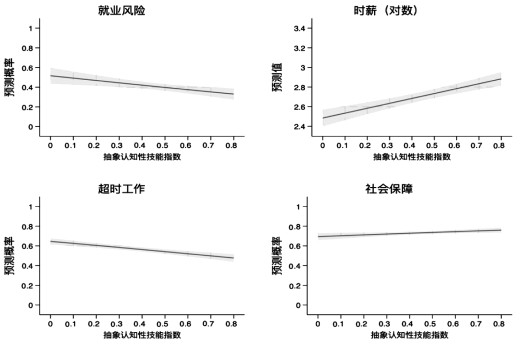
| 就业风险 | 时薪(对数) | 超时工作 | 社会保障 | ||||||||
| (1) | (2) | (1) | (2) | (1) | (2) | (1) | (2) | ||||
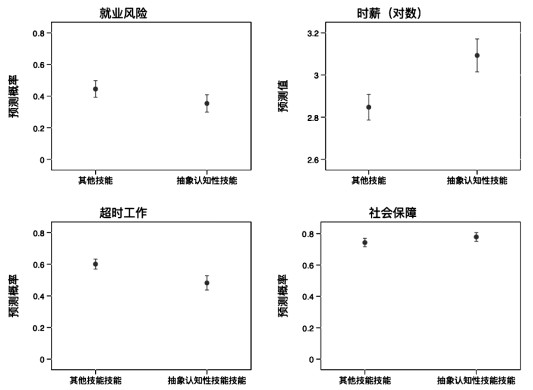
| 抽象认知性 技能指数 | -1.022** (0.348) | 0.530*** (0.082) | -0.820*** (0.215) | 0.568*** (0.172) | |||||||
| 抽象认知性 技能职业 | -0.407* (0.176) | 0.246*** (0.052) | -0.493*** (0.118) | 0.200+ (0.115) | |||||||
| 工作单位 | -0.718*** | -0.717*** | 0.039 | 0.038 | -0.695*** | -0.689*** | 0.665*** | 0.663*** | |||
| (0.135) | (0.136) | (0.037) | (0.037) | (0.067) | (0.067) | (0.080) | (0.080) | ||||
| 户籍类型 | -0.306** | -0.306** | 0.210*** | 0.210*** | -0.414*** | -0.413*** | 0.279*** | 0.279*** | |||
| (0.098) | (0.098) | (0.031) | (0.031) | (0.079) | (0.079) | (0.069) | (0.069) | ||||
| 受教育年限 | -0.097*** | -0.097*** | 0.076*** | 0.077*** | -0.074*** | -0.073*** | 0.177*** | 0.178*** | |||
| (0.013) | (0.013) | (0.006) | (0.006) | (0.013) | (0.013) | (0.014) | (0.014) | ||||
| 工作经验 | -0.026** | -0.026** | 0.029*** | 0.030*** | 0.014 | 0.014 | 0.086*** | 0.086*** | |||
| (0.010) | (0.010) | (0.006) | (0.006) | (0.008) | (0.008) | (0.008) | (0.008) | ||||
| 工作经验平方 | 0.001* | 0.001* | -0.001*** | -0.001*** | -0.001*** | -0.001*** | -0.001** | -0.001** | |||
| (0.000) | (0.000) | (0.000) | (0.000) | (0.000) | (0.000) | (0.000) | (0.000) | ||||
| 性别 | -0.048 | -0.049 | 0.278*** | 0.279*** | 0.379*** | 0.376*** | -0.015 | -0.017 | |||
| (0.063) | (0.063) | (0.032) | (0.032) | (0.044) | (0.043) | (0.048) | (0.047) | ||||
| 婚姻状况 | -0.199*** | -0.199*** | 0.014 | 0.014 | 0.129* | 0.128* | 0.187** | 0.187** | |||
| (0.056) | (0.056) | (0.038) | (0.038) | (0.062) | (0.063) | (0.067) | (0.067) | ||||
| 健康状况 | -0.126+ | -0.126+ | 0.196*** | 0.196*** | -0.120 | -0.120 | 0.006 | 0.006 | |||
| (0.069) | (0.069) | (0.050) | (0.050) | (0.102) | (0.102) | (0.076) | (0.076) | ||||
| 政治身份 | 0.121 | 0.120 | 0.099** | 0.098** | -0.049 | -0.044 | 0.503*** | 0.502*** | |||
| (0.098) | (0.098) | (0.034) | (0.034) | (0.070) | (0.070) | (0.112) | (0.113) | ||||
| 地区 | |||||||||||
| 东北 | 0.655*** | 0.655*** | -0.442*** | -0.444*** | 0.354*** | 0.356*** | -1.072*** | -1.072*** | |||
| (0.129) | (0.129) | (0.034) | (0.034) | (0.082) | (0.083) | (0.087) | (0.087) | ||||
| 中部 | 0.221 | 0.221 | -0.345*** | -0.346*** | 0.172** | 0.174** | -0.465*** | -0.464*** | |||
| (0.145) | (0.145) | (0.026) | (0.025) | (0.065) | (0.065) | (0.088) | (0.088) | ||||
| 西部 | 0.610*** | 0.611*** | -0.504*** | -0.504*** | 0.123+ | 0.125+ | -0.817*** | -0.817*** | |||
| (0.076) | (0.076) | (0.051) | (0.051) | (0.074) | (0.074) | (0.091) | (0.091) | ||||
| 年份 | |||||||||||
| 2018年 | -0.148** | -0.148** | 0.143*** | 0.144*** | 0.041 | 0.041 | 0.016 | 0.016 | |||
| (0.057) | (0.057) | (0.023) | (0.023) | (0.054) | (0.054) | (0.069) | (0.069) | ||||
| 2021年 | -0.098 | -0.099 | 0.217*** | 0.217*** | 0.415*** | 0.414*** | 0.126+ | 0.128+ | |||
| (0.139) | (0.139) | (0.028) | (0.029) | (0.072) | (0.073) | (0.072) | (0.072) | ||||
| 2023年 | 0.155 | 0.154 | 0.283*** | 0.284*** | 0.296** | 0.295** | 0.149 | 0.150 | |||
| (0.152) | (0.152) | (0.040) | (0.040) | (0.099) | (0.099) | (0.125) | (0.125) | ||||
| 截距 | 1.879*** | 1.576*** | 1.163*** | 1.304*** | 1.471*** | 1.291*** | -2.835*** | -2.658*** | |||
| (0.273) | (0.259) | (0.119) | (0.116) | (0.205) | (0.201) | (0.230) | (0.219) | ||||
| 随机效应 | 0.258*** | 0.299*** | 0.016*** | 0.020*** | 0.109*** | 0.101*** | 0.067* | 0.089** | |||
| (0.067) | (0.067) | (0.004) | (0.005) | (0.029) | (0.029) | (0.026) | (0.029) | ||||
| ICC | 0.073 | 0.083 | 0.021 | 0.026 | 0.032 | 0.030 | 0.020 | 0.026 | |||
| N | 12 819 | 10 213 | 11 783 | 12 082 | |||||||
"
"
"
| 就业风险 | 时薪(对数) | 超时工作 | 社会保障 | ||||||||
| (1) | (2) | (1) | (2) | (1) | (2) | (1) | (2) | ||||
| 抽象认知性技能指数 | -1.214** | 0.508*** | -1.137*** | 0.454* | |||||||
| (0.400) | (0.109) | (0.278) | (0.194) | ||||||||
| 抽象认知性技能职业 | -0.721** | 0.246*** | -0.749*** | 0.208 | |||||||
| (0.236) | (0.061) | (0.184) | (0.163) | ||||||||
| 工作单位 | -1.526*** | -1.048*** | 0.198** | 0.125** | -0.897*** | -0.774*** | 0.765*** | 0.666*** | |||
| (0.206) | (0.139) | (0.073) | (0.044) | (0.176) | (0.097) | (0.171) | (0.100) | ||||
| 户籍类型 | -0.225 | -0.353*** | 0.110* | 0.173*** | -0.595*** | -0.532*** | 0.218 | 0.353*** | |||
| (0.147) | (0.088) | (0.050) | (0.032) | (0.126) | (0.074) | (0.134) | (0.080) | ||||
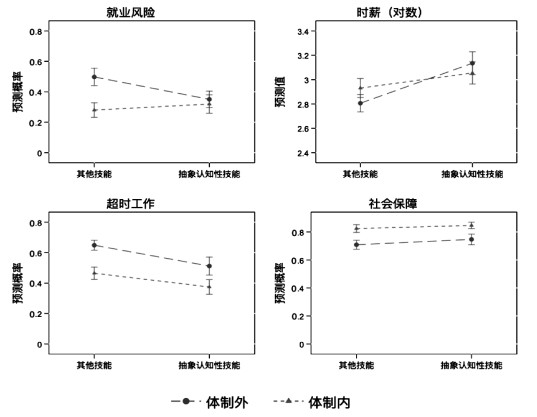
| 工作单位×抽象认知性技能指数/职业 | 1.800*** | 0.864*** | -0.332* | -0.205** | 0.410 | 0.195 | -0.245 | -0.029 | |||
| (0.400) | (0.212) | (0.145) | (0.074) | (0.326) | (0.147) | (0.318) | (0.161) | ||||
| 户籍类型×抽象认知性技能指数/职业 | -0.426 | -0.118 | 0.261* | 0.140* | 0.345 | 0.259* | 0.336 | 0.041 | |||
| (0.291) | (0.189) | (0.128) | (0.071) | (0.219) | (0.110) | (0.277) | (0.144) | ||||
| 控制变量 | 已控制 | 已控制 | 已控制 | 已控制 | 已控制 | 已控制 | 已控制 | 已控制 | |||
| 截距 | 2.002*** | 1.655*** | 1.171*** | 1.300*** | 1.631*** | 1.377*** | -2.844*** | -2.707*** | |||
| (0.272) | (0.254) | (0.131) | (0.119) | (0.206) | (0.199) | (0.224) | (0.216) | ||||
| 随机效应 | 略 | 略 | 略 | 略 | 略 | 略 | 略 | 略 | |||
| ICC | 0.079 | 0.093 | 0.022 | 0.024 | 0.030 | 0.029 | 0.012 | 0.018 | |||
| N | 12 819 | 10 213 | 11 783 | 12 082 | |||||||
"
"
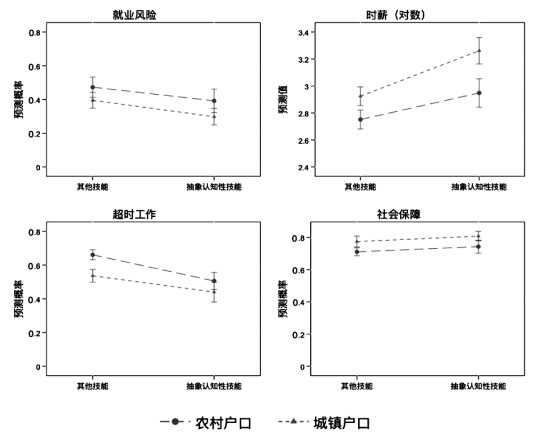
"
| 就业风险 | 时薪(对数) | 超时工作 | 社会保障 | ||||||||
| (1) | (2) | (1) | (2) | (1) | (2) | (1) | (2) | ||||
| 抽象认知性技能指数 | -1.333*** | 0.573*** | -1.198*** | 0.494* | |||||||
| (0.356) | (0.109) | (0.290) | (0.209) | ||||||||
| 抽象认知性技能职业 | -0.560** | 0.300*** | -0.750*** | 0.189 | |||||||
| (0.190) | (0.070) | (0.161) | (0.141) | ||||||||
| 工作单位×抽象认知性技能指数/职业 | 2.072*** | 0.947*** | -0.391** | -0.224** | 0.483 | 0.261* | -0.308 | -0.061 | |||
| (0.442) | (0.255) | (0.146) | (0.073) | (0.324) | (0.145) | (0.321) | (0.172) | ||||
| 户籍类型×抽象认知性技能指数/职业 | -0.395 | -0.163 | 0.279* | 0.135* | 0.307 | 0.235* | 0.359 | 0.053 | |||
| (0.328) | (0.182) | (0.117) | (0.063) | (0.223) | (0.116) | (0.284) | (0.142) | ||||
| N | 10 420 | 8 268 | 9 481 | 9 723 | |||||||
"
| 就业风险 | 时薪(对数) | 超时工作 | 社会保障 | ||||||||
| (1) | (2) | (1) | (2) | (1) | (2) | (1) | (2) | ||||
| 抽象认知性技能指数 | -1.292* | 0.390* | -1.430** | 0.456 | |||||||
| (0.486) | (0.189) | (0.437) | (0.328) | ||||||||
| 抽象认知性技能职业 | -0.605* | 0.180* | -0.584* | 0.096 | |||||||
| (0.282) | (0.104) | (0.245) | (0.180) | ||||||||
| 工作单位×抽象认知性技能指数/职业 | 1.270* | 0.609* | -0.251 | -0.225* | 0.584 | 0.368 | 0.234 | 0.310 | |||
| (0.503) | (0.316) | (0.237) | (0.128) | (0.562) | (0.351) | (0.580) | (0.268) | ||||
| 户籍类型×抽象认知性技能指数/职业 | -0.151 | -0.002 | 0.348* | 0.188* | 0.842* | 0.439** | 0.431 | 0.004 | |||
| (0.488) | (0.281) | (0.183) | (0.097) | (0.328) | (0.139) | (0.400) | (0.243) | ||||
| N | 3 958 | 3 087 | 3 410 | 3 700 | |||||||
| 边燕杰、 李路路、 李煜、 郝大海 . 2006. 结构壁垒、体制转型与地位资源含量[J]. 中国社会科学 (5): 100- 109. | |
| 蔡禾 . 2021. 新中国城乡关系发展与当下面临的问题[J]. 社会学评论 (1): 18- 28. | |
| 蔡禾、 史宇婷 . 2016. 劳动过程的去技术化、空间生产政治与超时加班——基于2012年中国劳动力动态调查数据的分析[J]. 西北师大学报(社会科学版) (1): 14- 24. | |
| 蔡跃洲、 陈楠 . 2019. 新技术革命下人工智能与高质量增长、高质量就业[J]. 数量经济技术经济研究 (5): 3- 22. | |
| 陈贵富、 韩静、 韩恺明 . 2022. 城市数字经济发展、技能偏向型技术进步与劳动力不充分就业[J]. 中国工业经济 (8): 118- 136. | |
| 陈媛媛、 张竞、 周亚虹 . 2022. 工业机器人与劳动力的空间配置[J]. 经济研究 (1): 172- 188. | |
| 程诚、 边燕杰 . 2014. 社会资本与不平等的再生产——以农民工与城市职工的收入差距为例[J]. 社会 (4): 67- 90. | |
| 董直庆、 蔡啸、 王林辉 . 2014. 技能溢价: 基于技术进步方向的解释[J]. 中国社会科学 (10): 22- 40. | |
| 郭娟娟、 张顺 . 2024. 数字经济时代的劳动力市场分割与职业流动的收入效应[J]. 浙江社会科学 (8): 99- 111. | |
| 郭凯明、 杭静、 颜色 . 2020. 资本深化、结构转型与技能溢价[J]. 经济研究 (9): 90- 105. | |
| 贺光烨、 吴晓刚 . 2015. 市场化、经济发展与中国城市中的性别收入不平等[J]. 社会学研究 (1): 140- 165. | |
| 胡涟漪、 盖庆恩、 朱喜、 郭士祺 . 2024. 中国职业技能结构转型: 任务内容的视角[J]. 经济研究 (1): 188- 207. | |
| 贾根良 . 2016. 第三次工业革命与工业智能化[J]. 中国社会科学 (6): 87- 106. | |
| 李汉林、 李路路 . 1999. 资源与交换——中国单位组织中的依赖性结构[J]. 社会学研究 (4): 46- 63. | |
| 李路路、 朱斌、 王煜 . 2016. 市场转型、劳动力市场分割与工作组织流动[J]. 中国社会科学 (9): 126- 145. | |
| 李培林 . 2021. 中国式现代化和新发展社会学[J]. 中国社会科学 (12): 4- 21. | |
| 李培林、 李炜 . 2010. 近年来农民工的经济状况和社会态度[J]. 中国社会科学 (1): 119- 131. | |
| 林易 . 2010. 凤凰男能飞多高——中国农转非男性的晋升之路[J]. 社会 (1): 88- 108. | |
| 刘甲楠、 邢春冰 . 2024. 人工智能、劳动力需求与人力资本投资[J]. 人口研究 (1): 68- 84. | |
| 刘思达 . 2023. 新发展格局下的当代中国职业研究——从劳动分工到专业技能[J]. 中国社会科学 (4): 63- 82. | |
| 卢晶亮 . 2018. 城镇劳动者工资不平等的演化: 1995-2013[J]. 经济学(季刊) (4): 1305- 1328. | |
| 亓寿伟、 刘智强 . 2009. 天花板效应还是地板效应——探讨国有与非国有部门性别工资差异的分布与成因[J]. 数量经济技术经济研究 (11): 63- 77. | |
| 王林辉、 胡晟明、 董直庆 . 2020. 人工智能技术会诱致劳动收入不平等吗-——模型推演与分类评估[J]. 中国工业经济 (4): 97- 115. | |
| 王林辉、 胡晟明、 董直庆 . 2022. 人工智能技术、任务属性与职业可替代风险: 来自微观层面的经验证据[J]. 管理世界 (7): 60- 79. | |
| 王林辉、 钱圆圆、 宋冬林、 董直庆 . 2023. 机器人应用的岗位转换效应及就业敏感性群体特征——来自微观个体层面的经验证据[J]. 经济研究 (7): 69- 85. | |
| 王林辉、 钱圆圆、 周慧琳、 董直庆 . 2023. 人工智能技术冲击和中国职业变迁方向[J]. 管理世界 (11): 74- 95. | |
| 王林辉、 袁礼 . 2018. 有偏型技术进步、产业结构变迁和中国要素收入分配格局[J]. 经济研究 (11): 115- 131. | |
| 王天夫、 崔晓雄 . 2010. 行业是如何影响收入的——基于多层线性模型的分析[J]. 中国社会科学 (5): 165- 180. | |
| 王星 . 2022. 从技能经济学到技能社会学: 技能形成研究的多元面向[J]. 社会学评论 (4): 33- 53. | |
| 王永钦、 董雯 . 2020. 机器人的兴起如何影响中国劳动力市场?——来自制造业上市公司的证据[J]. 经济研究 (10): 159- 175. | |
| 王永钦、 董雯 . 2023. 中国劳动力市场结构变迁——基于任务偏向型技术进步的视角[J]. 中国社会科学 (11): 45- 64. | |
| 吴彬彬、 章莉、 孟凡强 . 2020. 就业机会户籍歧视对收入差距的影响[J]. 中国人口科学 (6): 100- 111. | |
| 谢桂华 . 2007. 农民工与城市劳动力市场[J]. 社会学研究 (5): 84- 110. | |
| 谢嗣胜、 姚先国 . 2006. 农民工工资歧视的计量分析[J]. 中国农村经济 (4): 49- 55. | |
| 徐舒 . 2010. 技术进步、教育收益与收入不平等[J]. 经济研究 (9): 79- 92. | |
| 许怡、 叶欣 . 2020. 技术升级劳动降级?——基于三家机器换人工厂的社会学考察[J]. 社会学研究 (3): 23- 46. | |
| 杨虎涛、 冯鹏程 . 2020. 去技能化理论被证伪了吗?——基于就业极化与技能溢价的考察[J]. 当代经济研究 (10): 50- 63. | |
| 杨蕙馨、 李春梅 . 2013. 中国信息产业技术进步对劳动力就业及工资差距的影响[J]. 中国工业经济 (1): 51- 63. | |
| 姚先国、 周礼、 来君 . 2005. 技术进步、技能需求与就业结构——基于制造业微观数据的技能偏态假说检验[J]. 中国人口科学 (5): 47- 53. | |
| 余玲铮、 魏下海、 孙中伟、 吴春秀 . 2021. 工业机器人、工作任务与非常规能力溢价——来自制造业企业-工人匹配调查的证据[J]. 管理世界 (1): 47- 59. | |
| 张桂金、 张东 . 2019. 机器换人对工人工资影响的异质性效应: 基于中国的经验[J]. 学术论坛 (5): 18- 25. | |
| 张海东、 袁博 . 2024. 中国城市劳动力市场的双重二元分割——理论模型与实证检验[J]. 社会学研究 (3): 158- 181. | |
| 张海鹏 . 2019. 中国城乡关系演变70年: 从分割到融合[J]. 中国农村经济 (3): 2- 18. | |
| 张顺、 吕风光 . 2024. 数字时代的就业风险分配: 制度主义的视角[J]. 社会学研究 (5): 90- 112. | |
| 张咏雪 . 2024. 从自动化技术到生成式人工智能——技术对劳动者影响的技能异质性研究[J]. 社会学研究 (4): 69- 91. | |
| 周广肃、 李力行、 孟岭生 . 2021. 智能化对中国劳动力市场的影响——基于就业广度和强度的分析[J]. 金融研究 (6): 39- 58. | |
| 周扬、 谢宇 . 2019. 二元分割体制下城镇劳动力市场中的工作流动及其收入效应[J]. 社会 (4): 186- 209. | |
| 朱斌 . 2022. 稳定化与结构化——新制度主义视角下的中国劳动力市场变化(2006- 2017)[J]. 社会学研究 (2): 1- 22. | |
| Acemoglu, Daron . 2002. "Technical Change, Inequality, and the Labor Market." Journal of Economic Literature 40 (1): 7- 72. | |
| Acemoglu, Daron . 2003. "Patterns of Skill Premia." The Review of Economic Studies 70 (2): 199- 230. | |
| Acemoglu, Daron and David Autor. 2011. "Skills, Tasks and Technologies: Implications for Employment and Earnings. " In Handbook of Labor Economics (4), edited by O. Ashenfelter and D. E. Card. Amsterdam: Elsevier: 1043-1171. | |
| Acemoglu, Daron , David Autor , Jonathon Hazell and Pascual Restrepo . 2022. "Artificial Intelligence and Jobs: Evidence from Online Vacancies." Journal of Labor Economics 40 (S1): S293- S340. | |
| Acemoglu, Daron and Pascual Restrepo . 2018. "The Race between Man and Machine: Implications of Technology for Growth, Factor Shares, and Employment." American Economic Review 108 (6): 1488- 1542. | |
| Acemoglu, Daron and Pascual Restrepo . 2020. "Robots and Jobs: Evidence from US Labor Markets." Journal of Political Economy 128 (6): 2188- 2244. | |
| Acemoglu, Daron and Pascual Restrepo . 2022. "Tasks, Automation, and the Rise in U.S." Wage Inequality. Econometrica 90 (5): 1973- 2016. | |
| Althauser, Robert P. and Arne L. Kalleberg. 1981". Firms, Occupations, and the Structure of Labor Markets: A Conceptual Analysis. " In Sociological Perspectives on Labor Markets, edited by I. Berg. New York: Academic Press: 119-149. | |
| Autor, David H. 2019. "Work of the Past, Work of the Future. " Working Paper 25588, National Bureau of Economic Research. | |
| Autor, David H. , Katz Lawrence F. , Alan B. and Krueger . 1998. "Computing Inequality: Have Computers Changed the Labor Market?." The Quarterly Journal of Economics 113 (4): 1169- 1213. | |
| Bell, Daniel . 1973. The Coming of Post-Industrial Society: A Venture in Social Forecasting. New York: Basic Books. | |
| Blei, David M. . 2012. "Probabilistic Topic Models." Communications of the ACM 55 (4): 77- 84. | |
| Blei, David M. , Ng Andrew Y. , Michael I. and Jordan . 2003. "Latent Dirichlet Allocation." Journal of Machine Learning Research (3): 993- 1022. | |
| Braverman, Harry . 1974. Labor and Monopoly Capital: The Degradation of Work in the Twentieth Century. New York: Monthly Review Press. | |
| Caroli, Eve and John Van Reenen . 2001. "Skill-Biased Organizational Change? Evidence from a Panel of British and French Establishments." The Quarterly Journal of Economics 116 (4): 1449- 1492. | |
| Doeringer, Peter B. , Piore and Michael J. . 1971. Internal Labor Markets and Manpower Analysis. Lexington, Mass: D. C. Heath and Company. | |
| Esping-Andersen, Gøsta . 1993. Changing Classes: Stratification and Mobility in Post-Industrial Societies. London: Sage. | |
| Fernandez, Roberto M. . 2001. "Skill-Biased Technological Change and Wage Inequality: Evidence from a Plant Retooling." American Journal of Sociology 107 (2): 273- 320. | |
| Frey, Carl Benedikt , Michael A. and Osborne . 2017. "The Future of Employment: How Susceptible Are Jobs to Computerisation?." Technological Forecasting and Social Change 114: 254- 280. | |
| Gathmann, Christina and Uta Schönberg . 2010. "How General is Human Capital? A Task-Based Approach." Journal of Labor Economics 28 (1): 1- 49. | |
| Goldin, Claudia , Katz and Lawrence F. . 1998. "The Origins of Technology-Skill Complementarity." The Quarterly Journal of Economics 113 (3): 693- 732. | |
| Goldschmidt, Deborah , Schmieder and Johannes F. . 2017. "The Rise of Domestic Outsourcing and the Evolution of the German Wage Structure." The Quarterly Journal of Economics 132 (3): 1165- 1217. | |
| Gordon, David M. . 1996. Fat and Mean: The Corporate Squeeze of Working Americans and the Myth of Managerial "Downsizing". New York: Free Press. | |
| Graetz, Georg and Guy Michaels . 2018. "Robots at Work." Review of Economics and Statistics 100 (5): 753- 768. | |
| Griffiths, Thomas L. and Mark Steyvers . 2004. "Finding Scientific Topics." Proceedings of the National Academy of Sciences 101 (suppl_1): 5228- 5235. | |
| Kalleberg, Arne L. and Steven P. Vallas. 2017. "Probing Precarious Work: Theory, Research, and Politics. " In Precarious Work, edited by Arne L. Kalleberg and Steven P. Vallas. Emerald Publishing Limited: 1-30. | |
| Kambourov, Gueorgui and Iourii Manovskii . 2009. "Occupational Specificity of Human Capital." International Economic Review 50 (1): 63- 115. | |
| Keynes, John Maynard. 1930. "Economic Possibilities for Our Grandchildren. " In Essays in Persuasion. London: Palgrave Macmillan UK: 321-332. | |
| Krueger, Alan B. . 1993. "How Computers Have Changed the Wage Structure: Evidence from Microdata, 1984-1989." The Quarterly Journal of Economics 108 (1): 33- 60. | |
| Liu, Yujia , Grusky and David B. . 2013. "The Payoff to Skill in the Third Industrial Revolution." American Journal of Sociology 118 (5): 1330- 1374. | |
| Mincer, Jacob . 1974. Schooling, Experience, and Earnings. New York: Columbia University Press. | |
| Mouw, Ted , Kalleberg , Arne L. , Schultz and Michael A. . 2024. "'Stepping-Stone' versus 'Dead-End' Jobs: Occupational Structure, Work Experience, and Mobility Out of Low-Wage Jobs." American Sociological Review 89 (2): 298- 345. | |
| Newman, David, Jey Han Lau, Karl Grieser, and Timothy Baldwin. 2010. "Automatic Evaluation of Topic Coherence. " In Human Language Technologies: The 2010 Annual Conference of the North American Chapter of the Association for Computational Linguistics, edited by Ron Kaplan, Jill Burstein, Mary Harper, and Gerald Penn. Los Angeles, California: Association for Computational Linguistics: 100-108. | |
| Schor, Juliet B. , William Attwood-Charles , Mehmet Cansoy , Isak Ladegaard and Robert Wengronowitz . 2020. "Dependence and Precarity in the Platform Economy." Theory and Society 49: 833- 861. | |
| Smith,D. and Randall . 1983. "Mobility in Professional Occupational-Internal Labor Markets: Stratification, Segmentation and Vacancy Chains." American Sociological Review 48 (3): 289- 305. | |
| Spitz-Oener, Alexandra . 2006. "Technical Change, Job Tasks, and Rising Educational Demands: Looking Outside the Wage Structure." Journal of Labor Economics 24 (2): 235- 270. | |
| Sullivan, Paul . 2010. "Empirical Evidence on Occupation and Industry Specific Human Capital." Labour Economics 17 (3): 567- 580. |
| [1] |
Wang Fuqin.
Human Capital, Labor Market Segmentation and Income Distribution
[J]. Chinese Journal of Sociology, 2010, 30(1): 109-.
|
| Viewed | ||||||
|
Full text |
|
|||||
|
Abstract |
|
|||||
