
社会杂志 ›› 2026, Vol. 46 ›› Issue (2): 114-146.
乔天宇( ), 邱泽奇
出版日期:2026-03-20
发布日期:2026-05-19
作者简介:乔天宇 北京大学社会学系,E-mail: qiaotianyu@pku.edu.cn感谢刘世定、张静、周飞舟、刘能、卢云峰、李晓明、李国武、宋庆宇、张帆、刘学、赵一璋、马力、黄诗曼、肖亚宁等师友在数据收集、论文写作和修改过程中提供的指导和帮助,也感谢《社会》匿名评审给出的建设性意见。文责自负。
基金资助:
Tianyu QIAO(), Zeqi QIU
Online:2026-03-20
Published:2026-05-19
About author:QIAO Tianyu, Department of Sociology, Peking University, E-mail: qiaotianyu@pku.edu.cnSupported by:摘要:
对于乡村电商技术变革来说,边缘力量不容忽视。本文基于对山东省曹县一个电商村发展案例的考察,运用社会网络方法分析实地调查数据,发现村中最早尝试电商的创业者来自村庄社会结构的半边缘或边缘位置,而非村庄的核心成员,电商技能在村中的扩散也主要得益于边缘农户的推动。结合访谈调查与计算模拟实验,本文揭示了边缘农户能率先尝试并触发电商村形成的内在机制,发现边缘农户对待电商创业更开放的初始观念构成电商村形成的重要条件,电商村的形成同时还离不开由边缘农户带动的村庄群体观念更新。
乔天宇, 邱泽奇. 边缘农户触发的电商村形成[J]. 社会杂志, 2026, 46(2): 114-146.
Tianyu QIAO, Zeqi QIU. The Emergence of E-Commerce Village Tiggered by Marginal Peasant Households[J]. Chinese Journal of Sociology, 2026, 46(2): 114-146.
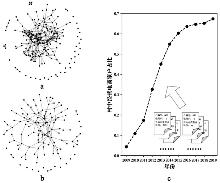
图 1:
南庄村的村庄人际关系网络、电商技能扩散网络和电商户占比动态"
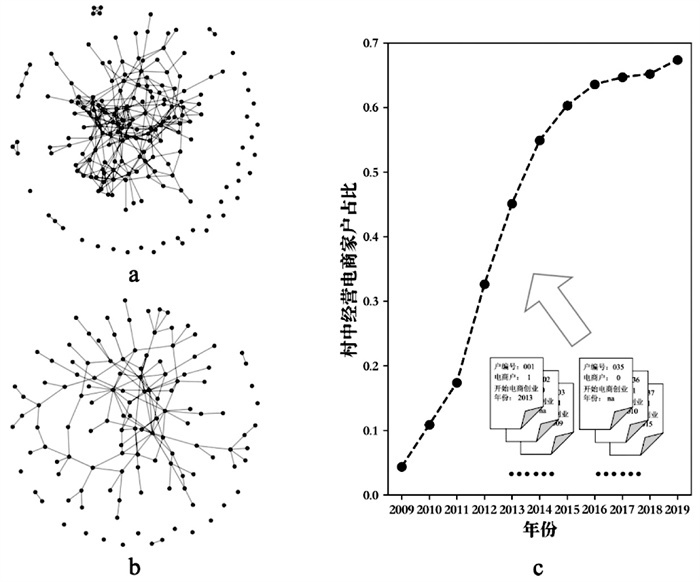

表 1:
南庄村村庄人际关系网络的密度矩阵"
| 核心 | 半边缘 | 边缘 | |
| 核心 | 0.295 | 0.020 | 0 |
| 半边缘 | 0.016 | 0.017 | 0.005 |
| 边缘 | 0 | 0.005 | 0.021 |
表 2:
对核心、半边缘与边缘的属性差异比较"
| 核心 | 半边缘 | 边缘 | P值 | |
| 年龄状况 | 36.833 (8.830) | 34.975 (15.648) | 38.326 (16.764) | F(2, 181) = 0.95 p = 0.389 |
| 劳动力人数 | 2 (0.426) | 2.438 (0.777) | 2.261 (0.768) | F(2, 181) = 2.323 p = 0.101 |
| 受教育程度 | ||||
| 小学及以下 | 3 (25.0) | 20 (25.0) | 28 (30.4) | Fisher精确度检验p = 0.397 |
| 初中 | 5 (41.7) | 23 (28.8) | 34 (37.0) | |
| 高中 | 3 (25.0) | 22 (27.5) | 17 (18.5) | |
| 大学及以上 | 1 (8.3) | 15 (18.8) | 13 (14.1) | |
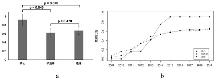
图 2:
核心、半边缘、边缘三类家户从事电商创业情况 注:1. a的纵轴代表模型预测的从事电商创业的概率。2. b的纵轴代表从事电商创业的家户占比,用来衡量各类家户电商创业的"
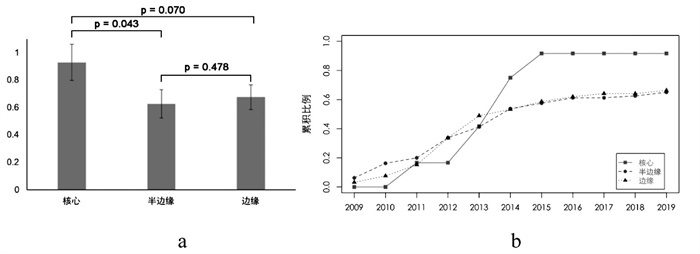
表 3:
南庄村家户电商创业发生风险的分段指数模型"
| 模型1a | 模型1b | 模型1c | |
| 时期(参照组:2015—2019年) | |||
| 2009—2012年 | 0.311*** | 0.048*** | 0.048** |
| [0.221,0.438] | [0.013,0.178] | [0.013,0.178] | |
| 2013—2014年 | 0.883 | 0.467** | 0.464** |
| [0.619,1.259] | [0.296,0.735] | [0.294,0.733] | |
| 结构位置(参照组:核心) | |||
| 半边缘 | 0.391*** | 0.422*** | |
| [0.261,0.586] | [0.276,0.646] | ||
| 边缘 | 0.444*** | 0.459*** | |
| [0.310,0.636] | [0.322,0.654] | ||
| 交互项 | |||
| 半边缘×(2009—2012年) | 8.328** | 8.091** | |
| [2.021,34.311] | [1.960,33.403] | ||
| 边缘×(2009—2012年) | 6.658** | 6.679** | |
| [1.650,26.861] | [1.656,26.932] | ||
| 半边缘×(2013—2014年) | 1.991+ | 1.963+ | |
| [0.989,4.008] | [0.977,3.944] | ||
| 边缘×(2013—2014年) | 1.887+ | 1.904+ | |
| [0.939,3.792] | [0.943,3.843] | ||
| 家户劳动力人口数 | 0.922 | ||
| [0.790,1.076] | |||
| 观测数 | 211 | 211 | 211 |
| 样本量 | 124 | 124 | 124 |
| 对数似然值 | -132.7 | -119.9 | -119.7 |
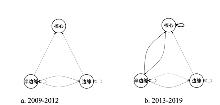
图 3:
电商技能在核心、半边缘和边缘位置内部以及相互之间的扩散"
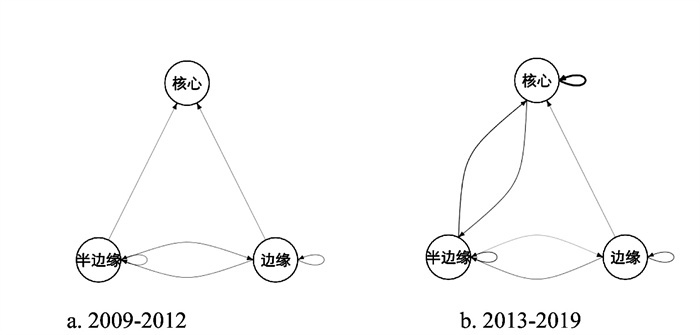
表 4:
对南庄村电商技能扩散网络动态的REM分析"
| 模型2a | 模型2b | 模型2c | |
| 发送者效应(参照组:核心= 0) | |||
| 发送者(半边缘) | 0.299 | 1.220* | |
| (0.323) | (0.725) | ||
| 发送者(边缘) | 0.233 | 1.241* | |
| (0.323) | (0.724) | ||
| 时期(参照组:2009—2012年) | |||
| 2013—2019年 | 1.021*** | 2.173** | |
| (0.160) | (0.782) | ||
| 交互项 | |||
| 发送者(半边缘)×(2013—2019年) | -1.051 | ||
| (0.817) | |||
| 发送者(边缘)×(2013—2019年) | -1.347+ | ||
| 发送者(边缘)×(2013—2019年) | (0.817) | ||
| 事件数 | 156 | 156 | |
| 观测数 | 689 | 689 | |
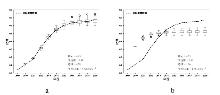
图 4:
利用计算模型模拟生成南庄村的电商村形成过程 注:各图中右下角给出的都是相应核心、半边缘与边缘初始门槛值均值的“最佳”参数组合;MSE表示均方误差(Mean鄄Square Error)。"
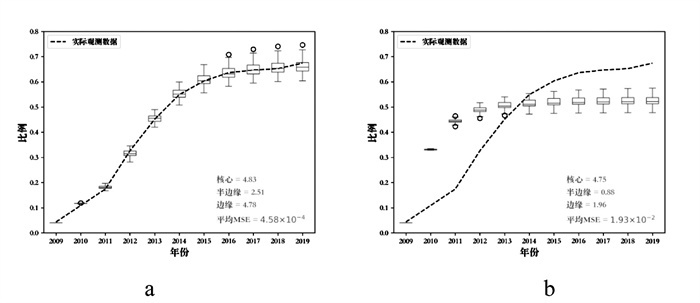
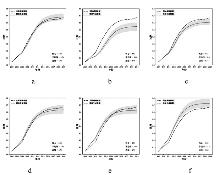
图 5:
模拟南庄村电商村形成的计算实验"
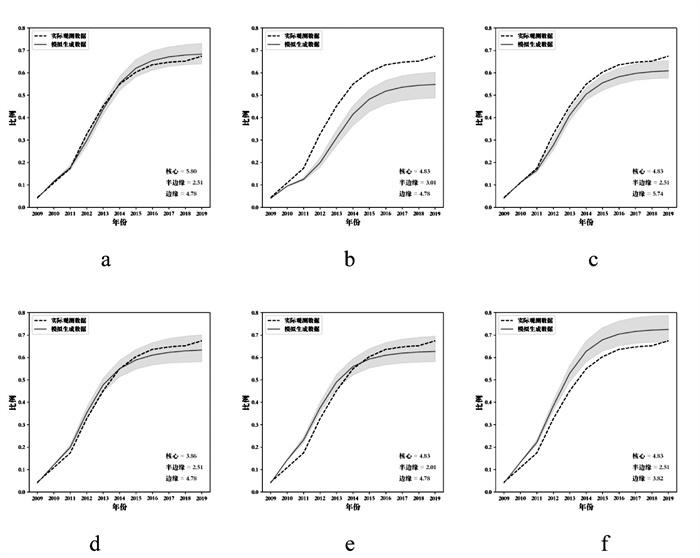
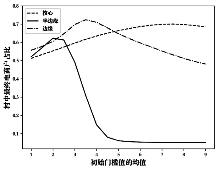
图 6:
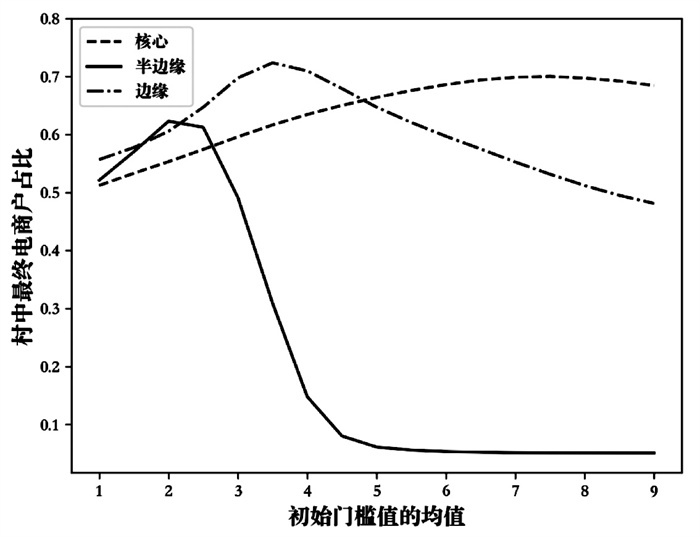
模拟电商村形成的计算实验:较大参数范围的分析"
| 波多尼, 乔尔. 2011. 地位的信号: 对市场竞争的社会学研究[M]. 张翔、艾云、张惠强, 译. 上海: 格致出版社. | |
| 伯特, 罗纳德. 2008. 结构洞: 竞争的社会结构[M]. 任敏、李璐、林虹, 译. 上海: 格致出版社. | |
| 陈立娟.2021.边缘革命四十年: 缘起、发展与局限[J].中国研究(2):14-28. | |
| 陈永富、方湖柳、曾亿武、郭红东.2018.电子商务促进农业产业集群升级的机理分析——以江苏省沭阳县花木产业集群为例[J].浙江社会科学(10):65-70. | |
| 陈云松、比蒂·沃克尔、亨克·弗莱普.2014.关系人没用吗?——社会资本求职效应的论战与新证[J].社会学研究(3):100-120. | |
| 崔丽丽、王骊静、王井泉.2014.社会创新因素促进淘宝村电子商务发展的实证分析——以浙江丽水为例[J].中国农村经济(12):50-60. | |
| 格兰诺维特, 马克. 2019. 社会与经济: 信任、权力与制度[M]. 王水雄、罗家德, 译. 北京: 中信出版社. | |
| 郭红东、曲江、曾亿武、邱东茂、陈东石、王铭莹. 2016. 沭阳模式——"互联网+三农"典范[R]. 浙江大学中国农村发展研究院(CARD)农村电商研究中心. https://pdf.dfcfw.com/pdf/H3_AP201703230430258402_1.pdf. | |
| 赫斯特洛姆, 彼得. 2010. 解析社会: 分析社会学原理[M]. 陈云松、范晓光、朱彦, 等, 译. 南京大学出版社. | |
| 胡泳.2020.数字位移: 重新思考数字化[M].北京:中国人民大学出版社. | |
| 蒋剑勇、郭红东.2012.创业氛围、社会网络和农民创业意向[J].中国农村观察(2):20-27. | |
| 蒋剑勇、钱文荣、郭红东.2014.社会网络、先前经验与农民创业决策[J].农业技术经济(2):17-25. | |
| 姜奇平.2015.互联网革命并非非'边缘革命'[J].互联网周刊(1):6. | |
| 科尔曼, 詹姆斯·S. 1999. 社会理论的基础[M]. 邓方, 译. 北京: 社会科学文献出版社. | |
| 科斯, 罗纳德·哈里、王宁. 2013. 变革中国: 市场经济的中国之路[M]. 徐尧、李哲民, 译. 北京: 中信出版社. | |
| 李培林.2021.中国式现代化与新发展社会学[J].中国社会科学(12):4-21. | |
| 林南. 2005. 社会资本: 关于社会结构与行动的理论[M]. 张磊, 译. 上海人民出版社. | |
| 刘滨、叶咏梅、康小兰、吴春雅.2019.农民电商创业行为选择及其影响因素分析——基于江西省150个农民电商创业户数据[J].农林经济管理学报(1):36-42. | |
| 刘杰、郑风田.2011.社会网络、个人职业选择与地区创业集聚——基于东风村的案例研究[J].管理世界(6):132-141. | |
| 刘军.2004.社会网络分析导论[M].北京:社会科学文献出版社. | |
| 刘俊杰、李超伟、韩思敏、张龙耀.2020.农村电商发展与农户数字信贷行为——来自江苏淘宝村的微观证据[J].中国农村经济(11):97-112. | |
| 刘学.2023.照护型政府: 一项基层政府产业角色的研究[J].学术月刊(1):127-137. | |
| 刘亚军.2017.互联网条件下的自发式包容性增长——基于一个淘宝村的纵向案例研究[J].社会科学(10):46-60. | |
| 刘亚军、储新民.2017.中国淘宝村的产业演化研究[J].中国软科学(2):29-36. | |
| 罗杰斯, E.M. 2016. 创新的扩散(第五版)[M]. 唐兴通, 译. 北京: 电子工业出版社. | |
| 乔天宇、邱泽奇.2020.复杂性研究与拓展社会学边界的机会[J].社会学研究(2):25-48. | |
| 邱泽奇.2018.三秩归一: 电商发展形塑的乡村秩序——菏泽市农村电商的案例分析[J].国家行政学院学报(1):47-54. | |
| 邱泽奇、黄诗曼.2021.熟人社会、外部市场和乡村电商创业的模仿与创新[J].社会学研究(4):133-158. | |
| 邱泽奇、乔天宇.2021.电商技术变革与农户共同发展[J].中国社会科学(10):145-166. | |
| 邱泽奇、张樹沁、刘世定、许英康.2016.从数字鸿沟到红利差异——互联网资本的视角[J].中国社会科学(10):93-115. | |
| 唐立强、周静.2018.社会资本、信息获取与农户电商行为[J].华南农业大学学报(社会科学版)(3):73-82. | |
| 汪凡、汪明峰.2020.基于格网的淘宝村集聚特征及影响因素分析[J].地理科学(2):229-237. | |
| 汪向东.2010.沙集模式及其意义[J].互联网周刊(23):107-110. | |
| 沃瑟曼, 斯坦利、凯瑟琳·福斯特. 2012. 社会网络分析: 方法与应用[M]. 陈禹、孙彩虹, 译. 北京: 中国人民大学出版社. | |
| 谢林, 托马斯·C. 2013. 微观动机与宏观行为[M]. 谢静、邓子梁、李天有, 译. 北京: 中国人民大学出版社. | |
| 信息社会50人论坛.2013.边缘革命2.0: 中国信息社会发展报告[M].上海远东出版社. | |
| 叶敬忠.2022.新发展社会学的想象[J].社会发展研究(1):56-80. | |
| 徐智邦、王中辉、周亮、王慧荣.2017.中国淘宝村的空间分布特征及驱动因素分析[J].经济地理(1):107-114. | |
| 伊斯利, 大卫、乔恩·克莱因伯格. 2011. 网络、群体与市场: 揭示高度互联世界的行为原理与效应机制[M]. 李晓明、王卫红、杨韫利, 译. 北京: 清华大学出版社. | |
| 姚中秋.2014.中国何以发生边缘革命[J].学术界(1):38-49. | |
| 于海云、汪长玉、赵增耀.2018.乡村电商创业集聚的动因及机理研究——以江苏沭阳淘宝村为例[J].经济管理(12):39-54. | |
| 曾亿武、陈永富、郭红东.2019.先前经验、社会资本与农户电商采纳行为[J].农业技术经济(3):38-48. | |
| 曾亿武、郭红东.2016.农产品淘宝村形成机理: 一个多案例研究[J].农业经济问题(4):39-48. | |
| 曾亿武、郭红东、金松青.2018.电子商务有益于农民增收吗?——来自江苏沭阳的证据[J].中国农村经济(2):49-64. | |
| 张曙光.2014.边缘革命、区域竞争和思想市场——读《变革中国——市场经济的中国之路》[J].读书(2):28-37. | |
| 张樹沁、邱泽奇.2022.乡村电商何以成功?——技术红利兑现机制的社会学分析[J].社会学研究(2):114-136. | |
| 周黎安. 2019. 淘宝村里的"草根逆袭" [N]. 社会科学报9月26日. | |
| Barton Allen,H..1968."Bringing Society Back in Survey Research and Macro-Methodology."The American Behavioral Scientist12(2):1-9. | |
| Bian,Yanjie.1997."Bringing Strong Ties Back in: Indirect Ties, Network Bridges, and Job Searches in China."American Sociological Review62(3):366-385. | |
| Bianchi,Federica,EdoardoFilippi-Mazzola,AlessandroLomi andWit ErnstC..2024."Relational Event Modeling."Annual Review of Statistics and Its Application11:297-319. | |
| Borgatti Stephen,P. andEverett MartinG..2000."Models of Core/Periphery Structures."Social Networks21(4):375-395. | |
| Borgatti Stephen,P.,Everett MartinG. andJohnson JeffreyC..2013.Analyzing Social Networks.Los Angeles:Sage. | |
| Borgatti Stephen,P. andHalgin DanielS..2011."On Network Theory."Organization Science22(5):1168-1181. | |
| Burt Ronald,S..1987."A Note on Missing Network Data in the General Social Survey."Social Networks9(1):63-73. | |
| Butts Carter,T..2008."A Relational Event Framework for Social Action."Sociological Methodology38:155-200. | |
| Butts, Carter T. and Christopher S. Marcum. 2017. "A Relational Event Approach to Modeling Behavioral Dynamics." In Group Processes: Data-Driven Computational Approaches, edited by Andrew Pilny and Marshalls Poole. Cham: Springer International Publishing. | |
| Cui,Miao,Pan ShanL. andCuiLili.2019."Developing Community Eapability for E-Commerce Development in Rural China: A Resource Orchestration Perspective."Information Systems Journal29(4):953-988. | |
| Cummings Jonathon,N. andRobCross.2003."Structural Properties of Work Groups and Their Consequences for Performance."Social Network25(3):197-210. | |
| DeGroot Morris,H..1974."Reaching a Consensus."Journal of the American Statistical Association69(345):118-121. | |
| Epstein Joshua,M. andRobertAxtell.1996.Growing Artificial Societies: Social Science from the Bottom Up.Washington:Brookings Institution Press. | |
| Granovetter,Mark.1973."The Strength of Weak Ties."American Journal of Sociology78(6):1360-1380. | |
| Granovetter,Mark.1978."Threshold Models of Collective Behavior."American Journal of Sociology83(6):1420-1443. | |
| Granovetter,Mark.1985."Economic Action and Social Structure: The Problem of Embeddedness."American Journal of Sociology91(3):481-510. | |
| Hillmann,Henning.2008."Mediation in Multiple Networks: Elite Mobilization before the English Civil War."American Sociological Review73(3):426-454. | |
| Holland Paul,W.,Laskey KathrynB. andSamuelLeinhardt.1983."Stochastic Blockmodels: First Steps."Social Networks5(2):109-137. | |
| Jan Piskorski,Mikołaj andAndreeaGorbatai.2017."Testing Coleman's Social-Norm Enforcement Mechanism: Evidence from Wikipedia."American Journal of Sociology122(4):1183-1222. | |
| Leong,Carmen,Pan ShanL.,SueNewell andCuiLili.2016."The Emergence of Self-Organizing E-Commerce Ecosystems in Remote Villages of China: A Tale of Digital Empowerment for Rural Development."MIS Quarterly40(2):475-484. | |
| Lin,Nan,Ensel WalterM. andVaughn JohnC..1981."Social Resources and Strength of Ties: Structural Factors in Occupational Status Attainment."American Sociological Review46(4):393-405. | |
| Liu,Min,ShiMin,MaWanglin andLiuTianjun.2021."The Adoption and Impact of E-Commerce in Rural China: Application of an Endogenous Switching Regression Model."Journal of Rural Studies83:106-116. | |
| Luo, Xubei and Chiyu Niu. 2019. "E-Commerce Participation and Household Income Growth in Taobao Villages." World Bank Policy Research, Working Paper No. 8811. Available at SSRN: https://papers.ssrn.com/sol3/papers.cfm?abstract_id=3369986 | |
| Malang,Thomas,LaurenceBrandenberger andPhilipLeifeld.2019."Networks and Social Influence in European Legislative Politics."British Journal of Political Science49(4):1475-1498. | |
| Mouw,Ted.2006."Estimating the Causal Effect of Social Capital: A Review of Recent Research."Annual Review of Sociology32:79-102. | |
| Natarajan,Mangai.2006."Understanding the Structure of a Large Heroin Distribution Network: A Quantitative Analysis of Qualitative Data."Journal of Quantitative Criminology22(2):171-192. | |
| Oberg,Achim,Korff ValeskaP. andPowell WalterW..2017."Culture and Connectivity Intertwined: Visualizing Organizational Fields as Relational Structures and Meaning Systems."Research in the Sociology of Organizations53:17-47. | |
| Qiao,Tianyu andQiuZeqi.2024."The Dynamic Process of Social Capital Transformation and the Emergence of E-Commerce Diffusion Networks."Journal of Rural Studies105:103101. | |
| Schrank,Andrew.2023.The Economic Sociology of Development.Hoboken:Polity Press. | |
| Shirley Mary,M.,NingWang andClaudeMénard.2015."Ronald Coase's Impact on Economics."Journal of Institutional Economics11(2):227-244. | |
| Snijders Tom,A. B..2011."Statistical Models for Social Networks."Annual Review of Sociology37(1):131-153. | |
| Stork,Diana andRichards WilliamD..1992."Nonrespondents in Communication Network Studies: Problems and Possibilities."Group & Organization Management17(2):193-209. | |
| Valeeva,Diliara,Heemskerk EelkeM. andTakes FrankW..2020."The Duality of Firms and Directors in Board Interlock Networks: A Relational Event Modeling Approach."Social Networks62:68-79. | |
| Vu,Duy,PhilippaPattison andGarryRobins.2015."Relational Event Models for Social Learning in MOOCs."Social Networks43:121-135. | |
| Wejnert,Barbara.2002."Integrating Models of Diffusion of Innovations: A Conceptual Framework."Annual Review of Sociology28(1):297-326. | |
| Zang,Yuzhu,HuShougeng,ZhouBing-bing,LvLigang andSuiXueyan.2023."Entrepreneurship and The Formation Mechanism of Taobao Villages: Implications for Sustainable Development in Rural Areas."Journal of Rural Studies100:103030. |
| [1] | 王路昊, 林海龙. 成为“最佳实践”:试点经验的话语建构[J]. 社会杂志, 2021, 41(1): 79-119. |
| [2] | 桂勇, 黄荣贵, 丁昳. 网络左翼的三重面相:基于个案观察和大数据的探索性研究[J]. 社会杂志, 2018, 38(3): 203-239. |
| [3] | 黄荣贵. 网络场域、文化认同与劳工关注社群:基于话题模型与社群侦测的大数据分析[J]. 社会杂志, 2017, 37(2): 26-50. |
| [4] | 刘军. QAP:测量“关系”之间关系的一种方法 [J]. 社会杂志, 2007, 27(4): 164-164 . |
| [5] | 刘 军. 法村社会支持网络的整体结构研究——块模型及其应用,[J]. 社会杂志, 2006, 26(3): 69-80. |
| 阅读次数 | ||||||
|
全文 |
|
|||||
|
摘要 |
|
|||||
