
社会杂志 ›› 2025, Vol. 45 ›› Issue (6): 208-238.
王鹏( ), 李桉涛, 刘欣
出版日期:2025-11-20
发布日期:2026-01-20
作者简介:王鹏 复旦大学社会发展与公共政策学院社会学系, E-mail: rmdxwp@163.com基金资助:
Peng WANG(), Antao LI, Xin LIU
Online:2025-11-20
Published:2026-01-20
About author:WANG Peng, Department of Sociology, School of Social Development and Public Policy, Fudan University, E-mail: rmdxwp@163.comSupported by:摘要:
近年来,以自动化和生成式人工智能为代表的技术革新正加速重塑劳动力市场,引发了学界对劳动力市场分化的广泛讨论。本文基于中国劳动力市场情境,结合互联网招聘大数据与调查数据,系统考察技术变革背景下技能分层及其与传统市场分割维度之间的关系。研究结果表明:首先,技能差异已成为分析中国劳动力市场分化的重要维度,从事更需要抽象认知性技能职业的劳动者在就业风险、收入水平、工作状况、社会保障等方面显著优于其他技能群体;其次,技能分层与传统制度分割呈现异质性的交互格局,体制内部门以制度庇护的方式弱化了技能回报分化的市场后果,户籍制度则未体现庇护作用,城镇户籍劳动者内部由技能引致的收入差距反而更大。这些结果反映了中国劳动力市场呈现出多重分割的状况,技术驱动的技能分割与原有制度逻辑共同形塑了分层秩序,凸显了中国式现代化进程中“叠加式转型”的复杂性。
王鹏, 李桉涛, 刘欣. 技术变革时代的技能回报与中国劳动力市场的多重分割[J]. 社会杂志, 2025, 45(6): 208-238.
Peng WANG, Antao LI, Xin LIU. The Returns on Skills in an Era of Technological Change and Multi-Dimensional Segmentation of Chinese Labor Market[J]. Chinese Journal of Sociology, 2025, 45(6): 208-238.

图 1:
职业技能词抽取提示词设计"


表 1:
职业技能分类"
| 技能小类 | 六分类 | 二分类 |
| 机械设计技能 | 非常规认知:分析性 | 抽象认知性技能 |
| 医药化学技能 | ||
| 电子工程技能 | ||
| 软件开发技能 | ||
| 财务经济技能 | ||
| 金融法务技能 | ||
| 美术设计技能 | ||
| 市场分析技能 | ||
| 生产管理技能 | 非常规认知:管理性 | |
| 工程管理技能 | ||
| 行政管理技能 | ||
| 市场营销技能 | 常规认知:市场性 | 非抽象认知性技能 |
| (其他技能) | ||
| 新媒体运营技能 | ||
| 客户维护技能 | ||
| 销售服务技能 | ||
| 行政办公技能 | 常规认知:行政性 | |
| 客户服务技能 | ||
| 劳动服务技能 | 非常规体力性 | |
| 设备操作技能 | 常规体力性 |
表 2:
主要变量描述统计"
| 变量 | 百分比/均值 | 标准差 |
| 劳动力市场后果 | ||
| 就业风险 | 40.3% | |
| 时薪对数 | 2.954 | 1.013 |
| 超时工作 | 56.1% | |
| 社会保障 | 70.9% | |
| 技能指标 | ||
| 抽象认知性技能指数 | 0.463 | 0.257 |
| 抽象认知性技能职业 | 42.1% | |
| 其他技能职业 | 57.9% | |
| 工作单位 | ||
| 体制外 | 72.5% | |
| 体制内 | 27.5% | |
| 户籍类型 | ||
| 农村户籍 | 48.8% | |
| 城镇户籍 | 51.2% | |
| 受教育年限 | 11.684 | 3.648 |
| 工作经验 | 19.882 | 11.828 |
| 工作经验平方 | 519.288 | 535.164 |
| 性别 | ||
| 女性 | 42.4% | |
| 男性 | 57.6% | |
| 婚姻状况 | ||
| 未婚 | 24.5% | |
| 已婚 | 75.5% | |
| 健康状况 | ||
| 一般以下 | 5.4% | |
| 一般及以上 | 94.6% | |
| 政治身份 | ||
| 非党员 | 87.3% | |
| 党员 | 12.7% | |
| 所在地区 | ||
| 东部 | 47.2% | |
| 东北 | 8.1% | |
| 中部 | 25.4% | |
| 西部 | 19.3% |
表 3:
技能分割基础模型分析结果"
| 就业风险 | 时薪(对数) | 超时工作 | 社会保障 | ||||||||
| (1) | (2) | (1) | (2) | (1) | (2) | (1) | (2) | ||||
| 抽象认知性 技能指数 | -1.022** (0.348) | 0.530*** (0.082) | -0.820*** (0.215) | 0.568*** (0.172) | |||||||
| 抽象认知性 技能职业 | -0.407* (0.176) | 0.246*** (0.052) | -0.493*** (0.118) | 0.200+ (0.115) | |||||||
| 工作单位 | -0.718*** | -0.717*** | 0.039 | 0.038 | -0.695*** | -0.689*** | 0.665*** | 0.663*** | |||
| (0.135) | (0.136) | (0.037) | (0.037) | (0.067) | (0.067) | (0.080) | (0.080) | ||||
| 户籍类型 | -0.306** | -0.306** | 0.210*** | 0.210*** | -0.414*** | -0.413*** | 0.279*** | 0.279*** | |||
| (0.098) | (0.098) | (0.031) | (0.031) | (0.079) | (0.079) | (0.069) | (0.069) | ||||
| 受教育年限 | -0.097*** | -0.097*** | 0.076*** | 0.077*** | -0.074*** | -0.073*** | 0.177*** | 0.178*** | |||
| (0.013) | (0.013) | (0.006) | (0.006) | (0.013) | (0.013) | (0.014) | (0.014) | ||||
| 工作经验 | -0.026** | -0.026** | 0.029*** | 0.030*** | 0.014 | 0.014 | 0.086*** | 0.086*** | |||
| (0.010) | (0.010) | (0.006) | (0.006) | (0.008) | (0.008) | (0.008) | (0.008) | ||||
| 工作经验平方 | 0.001* | 0.001* | -0.001*** | -0.001*** | -0.001*** | -0.001*** | -0.001** | -0.001** | |||
| (0.000) | (0.000) | (0.000) | (0.000) | (0.000) | (0.000) | (0.000) | (0.000) | ||||
| 性别 | -0.048 | -0.049 | 0.278*** | 0.279*** | 0.379*** | 0.376*** | -0.015 | -0.017 | |||
| (0.063) | (0.063) | (0.032) | (0.032) | (0.044) | (0.043) | (0.048) | (0.047) | ||||
| 婚姻状况 | -0.199*** | -0.199*** | 0.014 | 0.014 | 0.129* | 0.128* | 0.187** | 0.187** | |||
| (0.056) | (0.056) | (0.038) | (0.038) | (0.062) | (0.063) | (0.067) | (0.067) | ||||
| 健康状况 | -0.126+ | -0.126+ | 0.196*** | 0.196*** | -0.120 | -0.120 | 0.006 | 0.006 | |||
| (0.069) | (0.069) | (0.050) | (0.050) | (0.102) | (0.102) | (0.076) | (0.076) | ||||
| 政治身份 | 0.121 | 0.120 | 0.099** | 0.098** | -0.049 | -0.044 | 0.503*** | 0.502*** | |||
| (0.098) | (0.098) | (0.034) | (0.034) | (0.070) | (0.070) | (0.112) | (0.113) | ||||
| 地区 | |||||||||||
| 东北 | 0.655*** | 0.655*** | -0.442*** | -0.444*** | 0.354*** | 0.356*** | -1.072*** | -1.072*** | |||
| (0.129) | (0.129) | (0.034) | (0.034) | (0.082) | (0.083) | (0.087) | (0.087) | ||||
| 中部 | 0.221 | 0.221 | -0.345*** | -0.346*** | 0.172** | 0.174** | -0.465*** | -0.464*** | |||
| (0.145) | (0.145) | (0.026) | (0.025) | (0.065) | (0.065) | (0.088) | (0.088) | ||||
| 西部 | 0.610*** | 0.611*** | -0.504*** | -0.504*** | 0.123+ | 0.125+ | -0.817*** | -0.817*** | |||
| (0.076) | (0.076) | (0.051) | (0.051) | (0.074) | (0.074) | (0.091) | (0.091) | ||||
| 年份 | |||||||||||
| 2018年 | -0.148** | -0.148** | 0.143*** | 0.144*** | 0.041 | 0.041 | 0.016 | 0.016 | |||
| (0.057) | (0.057) | (0.023) | (0.023) | (0.054) | (0.054) | (0.069) | (0.069) | ||||
| 2021年 | -0.098 | -0.099 | 0.217*** | 0.217*** | 0.415*** | 0.414*** | 0.126+ | 0.128+ | |||
| (0.139) | (0.139) | (0.028) | (0.029) | (0.072) | (0.073) | (0.072) | (0.072) | ||||
| 2023年 | 0.155 | 0.154 | 0.283*** | 0.284*** | 0.296** | 0.295** | 0.149 | 0.150 | |||
| (0.152) | (0.152) | (0.040) | (0.040) | (0.099) | (0.099) | (0.125) | (0.125) | ||||
| 截距 | 1.879*** | 1.576*** | 1.163*** | 1.304*** | 1.471*** | 1.291*** | -2.835*** | -2.658*** | |||
| (0.273) | (0.259) | (0.119) | (0.116) | (0.205) | (0.201) | (0.230) | (0.219) | ||||
| 随机效应 | 0.258*** | 0.299*** | 0.016*** | 0.020*** | 0.109*** | 0.101*** | 0.067* | 0.089** | |||
| (0.067) | (0.067) | (0.004) | (0.005) | (0.029) | (0.029) | (0.026) | (0.029) | ||||
| ICC | 0.073 | 0.083 | 0.021 | 0.026 | 0.032 | 0.030 | 0.020 | 0.026 | |||
| N | 12 819 | 10 213 | 11 783 | 12 082 | |||||||
图 2:
抽象认知性技能指数与劳动力市场后果"
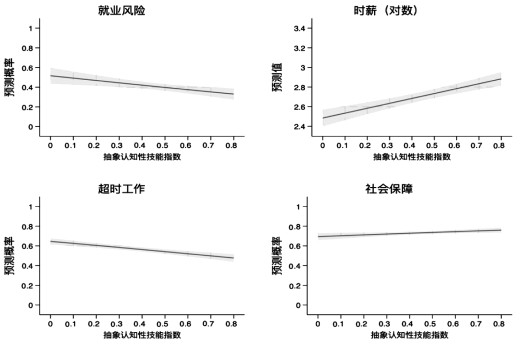
图 3:
不同技能需求职业与劳动力市场后果"
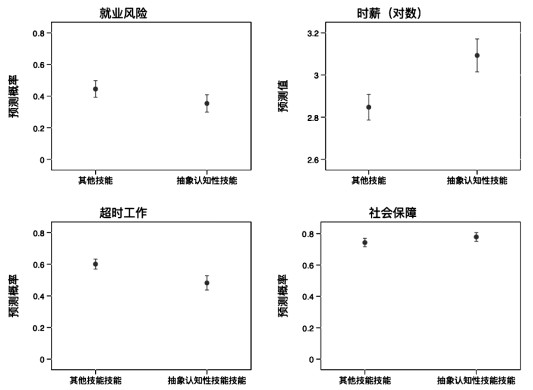
表 4:
技能分割的制度交互模型分析结果"
| 就业风险 | 时薪(对数) | 超时工作 | 社会保障 | ||||||||
| (1) | (2) | (1) | (2) | (1) | (2) | (1) | (2) | ||||
| 抽象认知性技能指数 | -1.214** | 0.508*** | -1.137*** | 0.454* | |||||||
| (0.400) | (0.109) | (0.278) | (0.194) | ||||||||
| 抽象认知性技能职业 | -0.721** | 0.246*** | -0.749*** | 0.208 | |||||||
| (0.236) | (0.061) | (0.184) | (0.163) | ||||||||
| 工作单位 | -1.526*** | -1.048*** | 0.198** | 0.125** | -0.897*** | -0.774*** | 0.765*** | 0.666*** | |||
| (0.206) | (0.139) | (0.073) | (0.044) | (0.176) | (0.097) | (0.171) | (0.100) | ||||
| 户籍类型 | -0.225 | -0.353*** | 0.110* | 0.173*** | -0.595*** | -0.532*** | 0.218 | 0.353*** | |||
| (0.147) | (0.088) | (0.050) | (0.032) | (0.126) | (0.074) | (0.134) | (0.080) | ||||
| 工作单位×抽象认知性技能指数/职业 | 1.800*** | 0.864*** | -0.332* | -0.205** | 0.410 | 0.195 | -0.245 | -0.029 | |||
| (0.400) | (0.212) | (0.145) | (0.074) | (0.326) | (0.147) | (0.318) | (0.161) | ||||
| 户籍类型×抽象认知性技能指数/职业 | -0.426 | -0.118 | 0.261* | 0.140* | 0.345 | 0.259* | 0.336 | 0.041 | |||
| (0.291) | (0.189) | (0.128) | (0.071) | (0.219) | (0.110) | (0.277) | (0.144) | ||||
| 控制变量 | 已控制 | 已控制 | 已控制 | 已控制 | 已控制 | 已控制 | 已控制 | 已控制 | |||
| 截距 | 2.002*** | 1.655*** | 1.171*** | 1.300*** | 1.631*** | 1.377*** | -2.844*** | -2.707*** | |||
| (0.272) | (0.254) | (0.131) | (0.119) | (0.206) | (0.199) | (0.224) | (0.216) | ||||
| 随机效应 | 略 | 略 | 略 | 略 | 略 | 略 | 略 | 略 | |||
| ICC | 0.079 | 0.093 | 0.022 | 0.024 | 0.030 | 0.029 | 0.012 | 0.018 | |||
| N | 12 819 | 10 213 | 11 783 | 12 082 | |||||||
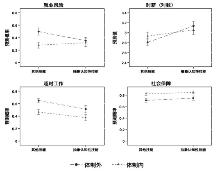
图 4:
体制内外:不同技能需求职业与劳动力市场后果"
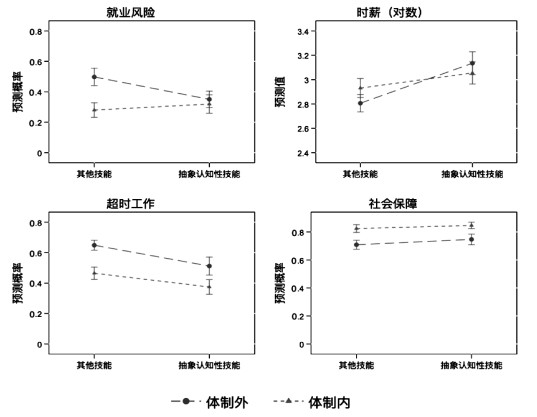
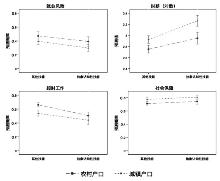
图 5:
城乡户籍:不同技能需求职业与劳动力市场后果"
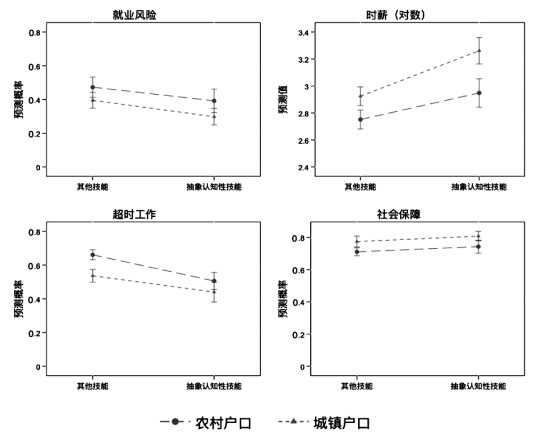
表 5:
技能分割的制度交互模型分析结果(受雇者)"
| 就业风险 | 时薪(对数) | 超时工作 | 社会保障 | ||||||||
| (1) | (2) | (1) | (2) | (1) | (2) | (1) | (2) | ||||
| 抽象认知性技能指数 | -1.333*** | 0.573*** | -1.198*** | 0.494* | |||||||
| (0.356) | (0.109) | (0.290) | (0.209) | ||||||||
| 抽象认知性技能职业 | -0.560** | 0.300*** | -0.750*** | 0.189 | |||||||
| (0.190) | (0.070) | (0.161) | (0.141) | ||||||||
| 工作单位×抽象认知性技能指数/职业 | 2.072*** | 0.947*** | -0.391** | -0.224** | 0.483 | 0.261* | -0.308 | -0.061 | |||
| (0.442) | (0.255) | (0.146) | (0.073) | (0.324) | (0.145) | (0.321) | (0.172) | ||||
| 户籍类型×抽象认知性技能指数/职业 | -0.395 | -0.163 | 0.279* | 0.135* | 0.307 | 0.235* | 0.359 | 0.053 | |||
| (0.328) | (0.182) | (0.117) | (0.063) | (0.223) | (0.116) | (0.284) | (0.142) | ||||
| N | 10 420 | 8 268 | 9 481 | 9 723 | |||||||
表 6:
技能分割的制度交互模型分析结果(CGSS2021和CGSS2023数据)"
| 就业风险 | 时薪(对数) | 超时工作 | 社会保障 | ||||||||
| (1) | (2) | (1) | (2) | (1) | (2) | (1) | (2) | ||||
| 抽象认知性技能指数 | -1.292* | 0.390* | -1.430** | 0.456 | |||||||
| (0.486) | (0.189) | (0.437) | (0.328) | ||||||||
| 抽象认知性技能职业 | -0.605* | 0.180* | -0.584* | 0.096 | |||||||
| (0.282) | (0.104) | (0.245) | (0.180) | ||||||||
| 工作单位×抽象认知性技能指数/职业 | 1.270* | 0.609* | -0.251 | -0.225* | 0.584 | 0.368 | 0.234 | 0.310 | |||
| (0.503) | (0.316) | (0.237) | (0.128) | (0.562) | (0.351) | (0.580) | (0.268) | ||||
| 户籍类型×抽象认知性技能指数/职业 | -0.151 | -0.002 | 0.348* | 0.188* | 0.842* | 0.439** | 0.431 | 0.004 | |||
| (0.488) | (0.281) | (0.183) | (0.097) | (0.328) | (0.139) | (0.400) | (0.243) | ||||
| N | 3 958 | 3 087 | 3 410 | 3 700 | |||||||
| 边燕杰、 李路路、 李煜、 郝大海 . 2006. 结构壁垒、体制转型与地位资源含量[J]. 中国社会科学 (5): 100- 109. | |
| 蔡禾 . 2021. 新中国城乡关系发展与当下面临的问题[J]. 社会学评论 (1): 18- 28. | |
| 蔡禾、 史宇婷 . 2016. 劳动过程的去技术化、空间生产政治与超时加班——基于2012年中国劳动力动态调查数据的分析[J]. 西北师大学报(社会科学版) (1): 14- 24. | |
| 蔡跃洲、 陈楠 . 2019. 新技术革命下人工智能与高质量增长、高质量就业[J]. 数量经济技术经济研究 (5): 3- 22. | |
| 陈贵富、 韩静、 韩恺明 . 2022. 城市数字经济发展、技能偏向型技术进步与劳动力不充分就业[J]. 中国工业经济 (8): 118- 136. | |
| 陈媛媛、 张竞、 周亚虹 . 2022. 工业机器人与劳动力的空间配置[J]. 经济研究 (1): 172- 188. | |
| 程诚、 边燕杰 . 2014. 社会资本与不平等的再生产——以农民工与城市职工的收入差距为例[J]. 社会 (4): 67- 90. | |
| 董直庆、 蔡啸、 王林辉 . 2014. 技能溢价: 基于技术进步方向的解释[J]. 中国社会科学 (10): 22- 40. | |
| 郭娟娟、 张顺 . 2024. 数字经济时代的劳动力市场分割与职业流动的收入效应[J]. 浙江社会科学 (8): 99- 111. | |
| 郭凯明、 杭静、 颜色 . 2020. 资本深化、结构转型与技能溢价[J]. 经济研究 (9): 90- 105. | |
| 贺光烨、 吴晓刚 . 2015. 市场化、经济发展与中国城市中的性别收入不平等[J]. 社会学研究 (1): 140- 165. | |
| 胡涟漪、 盖庆恩、 朱喜、 郭士祺 . 2024. 中国职业技能结构转型: 任务内容的视角[J]. 经济研究 (1): 188- 207. | |
| 贾根良 . 2016. 第三次工业革命与工业智能化[J]. 中国社会科学 (6): 87- 106. | |
| 李汉林、 李路路 . 1999. 资源与交换——中国单位组织中的依赖性结构[J]. 社会学研究 (4): 46- 63. | |
| 李路路、 朱斌、 王煜 . 2016. 市场转型、劳动力市场分割与工作组织流动[J]. 中国社会科学 (9): 126- 145. | |
| 李培林 . 2021. 中国式现代化和新发展社会学[J]. 中国社会科学 (12): 4- 21. | |
| 李培林、 李炜 . 2010. 近年来农民工的经济状况和社会态度[J]. 中国社会科学 (1): 119- 131. | |
| 林易 . 2010. 凤凰男能飞多高——中国农转非男性的晋升之路[J]. 社会 (1): 88- 108. | |
| 刘甲楠、 邢春冰 . 2024. 人工智能、劳动力需求与人力资本投资[J]. 人口研究 (1): 68- 84. | |
| 刘思达 . 2023. 新发展格局下的当代中国职业研究——从劳动分工到专业技能[J]. 中国社会科学 (4): 63- 82. | |
| 卢晶亮 . 2018. 城镇劳动者工资不平等的演化: 1995-2013[J]. 经济学(季刊) (4): 1305- 1328. | |
| 亓寿伟、 刘智强 . 2009. 天花板效应还是地板效应——探讨国有与非国有部门性别工资差异的分布与成因[J]. 数量经济技术经济研究 (11): 63- 77. | |
| 王林辉、 胡晟明、 董直庆 . 2020. 人工智能技术会诱致劳动收入不平等吗-——模型推演与分类评估[J]. 中国工业经济 (4): 97- 115. | |
| 王林辉、 胡晟明、 董直庆 . 2022. 人工智能技术、任务属性与职业可替代风险: 来自微观层面的经验证据[J]. 管理世界 (7): 60- 79. | |
| 王林辉、 钱圆圆、 宋冬林、 董直庆 . 2023. 机器人应用的岗位转换效应及就业敏感性群体特征——来自微观个体层面的经验证据[J]. 经济研究 (7): 69- 85. | |
| 王林辉、 钱圆圆、 周慧琳、 董直庆 . 2023. 人工智能技术冲击和中国职业变迁方向[J]. 管理世界 (11): 74- 95. | |
| 王林辉、 袁礼 . 2018. 有偏型技术进步、产业结构变迁和中国要素收入分配格局[J]. 经济研究 (11): 115- 131. | |
| 王天夫、 崔晓雄 . 2010. 行业是如何影响收入的——基于多层线性模型的分析[J]. 中国社会科学 (5): 165- 180. | |
| 王星 . 2022. 从技能经济学到技能社会学: 技能形成研究的多元面向[J]. 社会学评论 (4): 33- 53. | |
| 王永钦、 董雯 . 2020. 机器人的兴起如何影响中国劳动力市场?——来自制造业上市公司的证据[J]. 经济研究 (10): 159- 175. | |
| 王永钦、 董雯 . 2023. 中国劳动力市场结构变迁——基于任务偏向型技术进步的视角[J]. 中国社会科学 (11): 45- 64. | |
| 吴彬彬、 章莉、 孟凡强 . 2020. 就业机会户籍歧视对收入差距的影响[J]. 中国人口科学 (6): 100- 111. | |
| 谢桂华 . 2007. 农民工与城市劳动力市场[J]. 社会学研究 (5): 84- 110. | |
| 谢嗣胜、 姚先国 . 2006. 农民工工资歧视的计量分析[J]. 中国农村经济 (4): 49- 55. | |
| 徐舒 . 2010. 技术进步、教育收益与收入不平等[J]. 经济研究 (9): 79- 92. | |
| 许怡、 叶欣 . 2020. 技术升级劳动降级?——基于三家机器换人工厂的社会学考察[J]. 社会学研究 (3): 23- 46. | |
| 杨虎涛、 冯鹏程 . 2020. 去技能化理论被证伪了吗?——基于就业极化与技能溢价的考察[J]. 当代经济研究 (10): 50- 63. | |
| 杨蕙馨、 李春梅 . 2013. 中国信息产业技术进步对劳动力就业及工资差距的影响[J]. 中国工业经济 (1): 51- 63. | |
| 姚先国、 周礼、 来君 . 2005. 技术进步、技能需求与就业结构——基于制造业微观数据的技能偏态假说检验[J]. 中国人口科学 (5): 47- 53. | |
| 余玲铮、 魏下海、 孙中伟、 吴春秀 . 2021. 工业机器人、工作任务与非常规能力溢价——来自制造业企业-工人匹配调查的证据[J]. 管理世界 (1): 47- 59. | |
| 张桂金、 张东 . 2019. 机器换人对工人工资影响的异质性效应: 基于中国的经验[J]. 学术论坛 (5): 18- 25. | |
| 张海东、 袁博 . 2024. 中国城市劳动力市场的双重二元分割——理论模型与实证检验[J]. 社会学研究 (3): 158- 181. | |
| 张海鹏 . 2019. 中国城乡关系演变70年: 从分割到融合[J]. 中国农村经济 (3): 2- 18. | |
| 张顺、 吕风光 . 2024. 数字时代的就业风险分配: 制度主义的视角[J]. 社会学研究 (5): 90- 112. | |
| 张咏雪 . 2024. 从自动化技术到生成式人工智能——技术对劳动者影响的技能异质性研究[J]. 社会学研究 (4): 69- 91. | |
| 周广肃、 李力行、 孟岭生 . 2021. 智能化对中国劳动力市场的影响——基于就业广度和强度的分析[J]. 金融研究 (6): 39- 58. | |
| 周扬、 谢宇 . 2019. 二元分割体制下城镇劳动力市场中的工作流动及其收入效应[J]. 社会 (4): 186- 209. | |
| 朱斌 . 2022. 稳定化与结构化——新制度主义视角下的中国劳动力市场变化(2006- 2017)[J]. 社会学研究 (2): 1- 22. | |
| Acemoglu, Daron . 2002. "Technical Change, Inequality, and the Labor Market." Journal of Economic Literature 40 (1): 7- 72. | |
| Acemoglu, Daron . 2003. "Patterns of Skill Premia." The Review of Economic Studies 70 (2): 199- 230. | |
| Acemoglu, Daron and David Autor. 2011. "Skills, Tasks and Technologies: Implications for Employment and Earnings. " In Handbook of Labor Economics (4), edited by O. Ashenfelter and D. E. Card. Amsterdam: Elsevier: 1043-1171. | |
| Acemoglu, Daron , David Autor , Jonathon Hazell and Pascual Restrepo . 2022. "Artificial Intelligence and Jobs: Evidence from Online Vacancies." Journal of Labor Economics 40 (S1): S293- S340. | |
| Acemoglu, Daron and Pascual Restrepo . 2018. "The Race between Man and Machine: Implications of Technology for Growth, Factor Shares, and Employment." American Economic Review 108 (6): 1488- 1542. | |
| Acemoglu, Daron and Pascual Restrepo . 2020. "Robots and Jobs: Evidence from US Labor Markets." Journal of Political Economy 128 (6): 2188- 2244. | |
| Acemoglu, Daron and Pascual Restrepo . 2022. "Tasks, Automation, and the Rise in U.S." Wage Inequality. Econometrica 90 (5): 1973- 2016. | |
| Althauser, Robert P. and Arne L. Kalleberg. 1981". Firms, Occupations, and the Structure of Labor Markets: A Conceptual Analysis. " In Sociological Perspectives on Labor Markets, edited by I. Berg. New York: Academic Press: 119-149. | |
| Autor, David H. 2019. "Work of the Past, Work of the Future. " Working Paper 25588, National Bureau of Economic Research. | |
| Autor, David H. , Katz Lawrence F. , Alan B. and Krueger . 1998. "Computing Inequality: Have Computers Changed the Labor Market?." The Quarterly Journal of Economics 113 (4): 1169- 1213. | |
| Bell, Daniel . 1973. The Coming of Post-Industrial Society: A Venture in Social Forecasting. New York: Basic Books. | |
| Blei, David M. . 2012. "Probabilistic Topic Models." Communications of the ACM 55 (4): 77- 84. | |
| Blei, David M. , Ng Andrew Y. , Michael I. and Jordan . 2003. "Latent Dirichlet Allocation." Journal of Machine Learning Research (3): 993- 1022. | |
| Braverman, Harry . 1974. Labor and Monopoly Capital: The Degradation of Work in the Twentieth Century. New York: Monthly Review Press. | |
| Caroli, Eve and John Van Reenen . 2001. "Skill-Biased Organizational Change? Evidence from a Panel of British and French Establishments." The Quarterly Journal of Economics 116 (4): 1449- 1492. | |
| Doeringer, Peter B. , Piore and Michael J. . 1971. Internal Labor Markets and Manpower Analysis. Lexington, Mass: D. C. Heath and Company. | |
| Esping-Andersen, Gøsta . 1993. Changing Classes: Stratification and Mobility in Post-Industrial Societies. London: Sage. | |
| Fernandez, Roberto M. . 2001. "Skill-Biased Technological Change and Wage Inequality: Evidence from a Plant Retooling." American Journal of Sociology 107 (2): 273- 320. | |
| Frey, Carl Benedikt , Michael A. and Osborne . 2017. "The Future of Employment: How Susceptible Are Jobs to Computerisation?." Technological Forecasting and Social Change 114: 254- 280. | |
| Gathmann, Christina and Uta Schönberg . 2010. "How General is Human Capital? A Task-Based Approach." Journal of Labor Economics 28 (1): 1- 49. | |
| Goldin, Claudia , Katz and Lawrence F. . 1998. "The Origins of Technology-Skill Complementarity." The Quarterly Journal of Economics 113 (3): 693- 732. | |
| Goldschmidt, Deborah , Schmieder and Johannes F. . 2017. "The Rise of Domestic Outsourcing and the Evolution of the German Wage Structure." The Quarterly Journal of Economics 132 (3): 1165- 1217. | |
| Gordon, David M. . 1996. Fat and Mean: The Corporate Squeeze of Working Americans and the Myth of Managerial "Downsizing". New York: Free Press. | |
| Graetz, Georg and Guy Michaels . 2018. "Robots at Work." Review of Economics and Statistics 100 (5): 753- 768. | |
| Griffiths, Thomas L. and Mark Steyvers . 2004. "Finding Scientific Topics." Proceedings of the National Academy of Sciences 101 (suppl_1): 5228- 5235. | |
| Kalleberg, Arne L. and Steven P. Vallas. 2017. "Probing Precarious Work: Theory, Research, and Politics. " In Precarious Work, edited by Arne L. Kalleberg and Steven P. Vallas. Emerald Publishing Limited: 1-30. | |
| Kambourov, Gueorgui and Iourii Manovskii . 2009. "Occupational Specificity of Human Capital." International Economic Review 50 (1): 63- 115. | |
| Keynes, John Maynard. 1930. "Economic Possibilities for Our Grandchildren. " In Essays in Persuasion. London: Palgrave Macmillan UK: 321-332. | |
| Krueger, Alan B. . 1993. "How Computers Have Changed the Wage Structure: Evidence from Microdata, 1984-1989." The Quarterly Journal of Economics 108 (1): 33- 60. | |
| Liu, Yujia , Grusky and David B. . 2013. "The Payoff to Skill in the Third Industrial Revolution." American Journal of Sociology 118 (5): 1330- 1374. | |
| Mincer, Jacob . 1974. Schooling, Experience, and Earnings. New York: Columbia University Press. | |
| Mouw, Ted , Kalleberg , Arne L. , Schultz and Michael A. . 2024. "'Stepping-Stone' versus 'Dead-End' Jobs: Occupational Structure, Work Experience, and Mobility Out of Low-Wage Jobs." American Sociological Review 89 (2): 298- 345. | |
| Newman, David, Jey Han Lau, Karl Grieser, and Timothy Baldwin. 2010. "Automatic Evaluation of Topic Coherence. " In Human Language Technologies: The 2010 Annual Conference of the North American Chapter of the Association for Computational Linguistics, edited by Ron Kaplan, Jill Burstein, Mary Harper, and Gerald Penn. Los Angeles, California: Association for Computational Linguistics: 100-108. | |
| Schor, Juliet B. , William Attwood-Charles , Mehmet Cansoy , Isak Ladegaard and Robert Wengronowitz . 2020. "Dependence and Precarity in the Platform Economy." Theory and Society 49: 833- 861. | |
| Smith,D. and Randall . 1983. "Mobility in Professional Occupational-Internal Labor Markets: Stratification, Segmentation and Vacancy Chains." American Sociological Review 48 (3): 289- 305. | |
| Spitz-Oener, Alexandra . 2006. "Technical Change, Job Tasks, and Rising Educational Demands: Looking Outside the Wage Structure." Journal of Labor Economics 24 (2): 235- 270. | |
| Sullivan, Paul . 2010. "Empirical Evidence on Occupation and Industry Specific Human Capital." Labour Economics 17 (3): 567- 580. |
| [1] | 王甫勤. 人力资本、劳动力市场分割与收入分配[J]. 社会杂志, 2010, 30(1): 109-. |
| [2] | 王甫勤. 人力资本、劳动力市场分割与收入分配[J]. 社会杂志, 2010, 30(1): 109-126. |
| 阅读次数 | ||||||
|
全文 |
|
|||||
|
摘要 |
|
|||||
