
社会杂志 ›› 2026, Vol. 46 ›› Issue (4): 98-135.
何龙韬, 张晶*( )
出版日期:2026-07-20
发布日期:2026-09-18
通讯作者:
张晶
作者简介:何龙韬 西南财经大学社会发展研究院
HE Longtao, Institute for Social Development, Southwestern University of Finance and Economics
基金资助:
Longtao HE, Jing ZHANG*()
Online:2026-07-20
Published:2026-09-18
Contact:
Jing ZHANG
Supported by:摘要:
在人机共存日益成为数字时代社会实践重要特征的背景下,人工智能如何进入安宁疗护社会工作实践,并与人类形成稳定的照护关系,仍缺乏基于具体实践的社会学解释。基于某三甲医院人工智能赋能安宁疗护社会工作干预项目,本文在实践评估中嵌入质性研究,从互动关系、组织协作与伦理治理三个层面考察人工智能参与照护实践的生成过程。研究发现,人工智能在安宁疗护中的作用并非技术预设,而是在持续的情境磨合、情感互动与伦理协商中逐渐形成,并由此重构照护互动、情感劳动与责任边界。本文提出“动态适配—情感调节—伦理共构”分析框架,认为人机共存并非人与技术的简单协作,而是人工智能在具体照护实践中不断获得在场性、关系性与正当性的生成过程。
何龙韬, 张晶. 人机共存的生成机制:以安宁疗护社会工作实践为例[J]. 社会杂志, 2026, 46(4): 98-135.
Longtao HE, Jing ZHANG. The Construction of Human-AI Coexistence: Evidence from Palliative Care Social Work Practice[J]. Chinese Journal of Sociology, 2026, 46(4): 98-135.

表 1:
质性研究参与者的人口学特征与不同角色 (N = 76)"
| 参与者类别 | 人数 | 性别分布 | 年龄分布 | 主要特征说明 |
| 服务对象(患者及家属) | 58 | 男性2 5人 女性33人 | 3 5~49岁:12人 50~64岁:2 1人 65岁及以上:25人 | 覆盖不同病程阶段;包括患者本人及其主要照护者;社会经济背景多样 |
| 社会工作者 | 7 | 男性0人 女性7人 | 18~24岁:6人 25~34岁:1人 | 均具有安宁疗护相关工作经验,参与AI协同干预的一线实施与伦理判断 |
| 医护人员 | 6 | 男性1人 女性5人 | 25~34岁:2人 35~44岁:3人 45岁及以上:1人 | 包括医生与护士,负责病情管理、跨专业协作与风险评估 |
| AI技术人员 | 5 | 男性5人 女性0人 | 25~34岁:4人 35~44岁:1人 | 负责系统研发、维护与算法参数调整,不直接参与临床决策 |
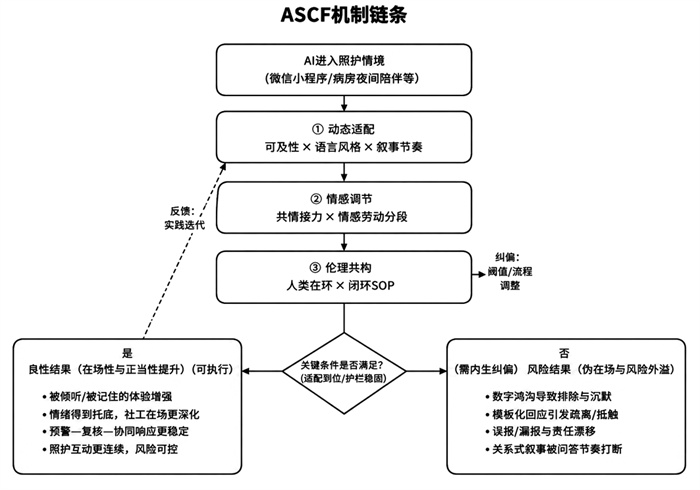
图 1:
安宁疗护社会工作中人机共存的生成机制"
|
肖瑛. 2020. 反思与自反: 反身性视野下的社会学与风险社会[M]. 北京: 商务印书馆.
|
|
|
肖瑛. 2020. 反思与自反: 反身性视野下的社会学与风险社会[M]. 北京: 商务印书馆.
|
|
|
肖瑛. 2020. 反思与自反: 反身性视野下的社会学与风险社会[M]. 北京: 商务印书馆.
|
|
|
肖瑛. 2020. 反思与自反: 反身性视野下的社会学与风险社会[M]. 北京: 商务印书馆.
|
|
|
肖瑛. 2020. 反思与自反: 反身性视野下的社会学与风险社会[M]. 北京: 商务印书馆.
|
|
|
肖瑛. 2020. 反思与自反: 反身性视野下的社会学与风险社会[M]. 北京: 商务印书馆.
|
|
|
肖瑛. 2020. 反思与自反: 反身性视野下的社会学与风险社会[M]. 北京: 商务印书馆.
|
|
|
肖瑛. 2020. 反思与自反: 反身性视野下的社会学与风险社会[M]. 北京: 商务印书馆.
|
|
|
肖瑛. 2020. 反思与自反: 反身性视野下的社会学与风险社会[M]. 北京: 商务印书馆.
|
|
|
肖瑛. 2020. 反思与自反: 反身性视野下的社会学与风险社会[M]. 北京: 商务印书馆.
|
|
|
肖瑛. 2020. 反思与自反: 反身性视野下的社会学与风险社会[M]. 北京: 商务印书馆.
|
|
|
肖瑛. 2020. 反思与自反: 反身性视野下的社会学与风险社会[M]. 北京: 商务印书馆.
|
|
|
Deleuze, Gilles and Michel Foucault. 1977. "Intellectuals and Power. " In Language, Counter-Memory, Practice, edited by Donald F. Bouchard. Ithaca: Cornell University Press: 205-217.
|
|
|
Deleuze, Gilles and Michel Foucault. 1977. "Intellectuals and Power. " In Language, Counter-Memory, Practice, edited by Donald F. Bouchard. Ithaca: Cornell University Press: 205-217.
|
|
|
Deleuze, Gilles and Michel Foucault. 1977. "Intellectuals and Power. " In Language, Counter-Memory, Practice, edited by Donald F. Bouchard. Ithaca: Cornell University Press: 205-217.
|
|
|
Deleuze, Gilles and Michel Foucault. 1977. "Intellectuals and Power. " In Language, Counter-Memory, Practice, edited by Donald F. Bouchard. Ithaca: Cornell University Press: 205-217.
|
|
|
Deleuze, Gilles and Michel Foucault. 1977. "Intellectuals and Power. " In Language, Counter-Memory, Practice, edited by Donald F. Bouchard. Ithaca: Cornell University Press: 205-217.
|
|
|
Heidegger, Martin. 1954. "The Question Concerning Technology. " In Technology and Values: Essential Readings, New York: John Wiley & Sons: 99-113.
|
|
|
Heidegger, Martin. 1954. "The Question Concerning Technology. " In Technology and Values: Essential Readings, New York: John Wiley & Sons: 99-113.
|
|
|
Heidegger, Martin. 1954. "The Question Concerning Technology. " In Technology and Values: Essential Readings, New York: John Wiley & Sons: 99-113.
|
|
|
Heidegger, Martin. 1954. "The Question Concerning Technology. " In Technology and Values: Essential Readings, New York: John Wiley & Sons: 99-113.
|
|
|
Heidegger, Martin. 1954. "The Question Concerning Technology. " In Technology and Values: Essential Readings, New York: John Wiley & Sons: 99-113.
|
|
|
Heidegger, Martin. 1954. "The Question Concerning Technology. " In Technology and Values: Essential Readings, New York: John Wiley & Sons: 99-113.
|
|
|
Heidegger, Martin. 1954. "The Question Concerning Technology. " In Technology and Values: Essential Readings, New York: John Wiley & Sons: 99-113.
|
|
|
Heidegger, Martin. 1954. "The Question Concerning Technology. " In Technology and Values: Essential Readings, New York: John Wiley & Sons: 99-113.
|
|
|
Heidegger, Martin. 1954. "The Question Concerning Technology. " In Technology and Values: Essential Readings, New York: John Wiley & Sons: 99-113.
|
|
|
Heidegger, Martin. 1954. "The Question Concerning Technology. " In Technology and Values: Essential Readings, New York: John Wiley & Sons: 99-113.
|
|
|
Heidegger, Martin. 1954. "The Question Concerning Technology. " In Technology and Values: Essential Readings, New York: John Wiley & Sons: 99-113.
|
|
|
Heidegger, Martin. 1954. "The Question Concerning Technology. " In Technology and Values: Essential Readings, New York: John Wiley & Sons: 99-113.
|
|
|
Heidegger, Martin. 1954. "The Question Concerning Technology. " In Technology and Values: Essential Readings, New York: John Wiley & Sons: 99-113.
|
|
|
Heidegger, Martin. 1954. "The Question Concerning Technology. " In Technology and Values: Essential Readings, New York: John Wiley & Sons: 99-113.
|
|
|
Heidegger, Martin. 1954. "The Question Concerning Technology. " In Technology and Values: Essential Readings, New York: John Wiley & Sons: 99-113.
|
|
|
Heidegger, Martin. 1954. "The Question Concerning Technology. " In Technology and Values: Essential Readings, New York: John Wiley & Sons: 99-113.
|
|
|
Heidegger, Martin. 1954. "The Question Concerning Technology. " In Technology and Values: Essential Readings, New York: John Wiley & Sons: 99-113.
|
|
|
Heidegger, Martin. 1954. "The Question Concerning Technology. " In Technology and Values: Essential Readings, New York: John Wiley & Sons: 99-113.
|
|
|
Heidegger, Martin. 1954. "The Question Concerning Technology. " In Technology and Values: Essential Readings, New York: John Wiley & Sons: 99-113.
|
|
|
Heidegger, Martin. 1954. "The Question Concerning Technology. " In Technology and Values: Essential Readings, New York: John Wiley & Sons: 99-113.
|
|
|
Heidegger, Martin. 1954. "The Question Concerning Technology. " In Technology and Values: Essential Readings, New York: John Wiley & Sons: 99-113.
|
|
|
Heidegger, Martin. 1954. "The Question Concerning Technology. " In Technology and Values: Essential Readings, New York: John Wiley & Sons: 99-113.
|
|
|
Heidegger, Martin. 1954. "The Question Concerning Technology. " In Technology and Values: Essential Readings, New York: John Wiley & Sons: 99-113.
|
|
|
Heidegger, Martin. 1954. "The Question Concerning Technology. " In Technology and Values: Essential Readings, New York: John Wiley & Sons: 99-113.
|
|
|
Heidegger, Martin. 1954. "The Question Concerning Technology. " In Technology and Values: Essential Readings, New York: John Wiley & Sons: 99-113.
|
|
|
Wang, Zijie, Dongjin Choi, Shenyu Xu, and Diyi Yang. 2021. "Putting Humans in the Natural Language Processing Loop: A Survey." arXiv Preprint. arXiv: 2103.04044.
|
|
|
Wang, Zijie, Dongjin Choi, Shenyu Xu, and Diyi Yang. 2021. "Putting Humans in the Natural Language Processing Loop: A Survey." arXiv Preprint. arXiv: 2103.04044.
|
|
|
Wang, Zijie, Dongjin Choi, Shenyu Xu, and Diyi Yang. 2021. "Putting Humans in the Natural Language Processing Loop: A Survey." arXiv Preprint. arXiv: 2103.04044.
|
|
|
Zuboff, Shoshana. 2019. "Surveillance Capitalism and the Challenge of Collective Action. " In New Labor Forum(Vol. 28). Los Angeles: Sage Publications: 10-29.
|
| [1] | 黄晖. 智能制造甘愿:人工智能训练的劳动组织形式与控制策略[J]. 社会杂志, 2025, 45(2): 1-31. |
| [2] | 李伟. 社会工作何以走向“去社会变革化”?基于美国百年社会工作史的分析[J]. 社会杂志, 2018, 38(4): 100-132. |
| [3] | 雷杰, 黄婉怡. 实用专业主义:广州市家庭综合服务中心社会工作者“专业能力”的界定及其逻辑[J]. 社会杂志, 2017, 37(1): 211-241. |
| [4] | 丁瑜 李会. 住院康复精神病人日常生活实践中的充权: 一个广州的个案研究 [J]. 社会杂志, 2013, 33(4): 117-146. |
| [5] | 张良广 . “批判诠释论”视角下的“争吵”事件——一个国际项目实施中的冲突与转向[J]. 社会杂志, 2010, 30(3): 130-135. |
| [6] | 童 敏. 中国本土社会工作专业实践的基本处境及其督导者的基本角色[J]. 社会杂志, 2006, 26(3): 194-204. |
| 阅读次数 | ||||||
|
全文 |
|
|||||
|
摘要 |
|
|||||
