
社会杂志 ›› 2026, Vol. 46 ›› Issue (1): 206-239.
• 论文 • 上一篇
孙静含, 李升*( ), 李科霖
出版日期:2026-01-20
发布日期:2026-03-17
通讯作者:
李升
E-mail:lisheng@bjut.edu.cn
作者简介:孙静含 北京工业大学社会学院、北京社会管理研究基地基金资助:
Jinghan SUN, Sheng LI*(), Kelin LI
Online:2026-01-20
Published:2026-03-17
Contact:
Sheng LI
E-mail:lisheng@bjut.edu.cn
About author:SUN Jinghan, School of Sociology, Beijing University of Technology; Beijing Social Governance Research CenterSupported by:摘要:
对中国人而言,看中医还是看西医是人们在治疗疾病或维持健康过程中常面临的选择。虽然已有研究从不同维度对健康的教育梯度的形成机制进行了探讨,但基于西医体系范式的研究结果并未重视看中医行为可能带来的影响。本文基于中国综合社会调查数据,通过构建有序链式中介模型,发现“看中医”(相比于看西医更倾向于看中医的行为)可以作为受教育程度和自评健康的中介变量,这一结果在经过稳健性检验和内生性检验后仍然成立。在影响机制解释上,中国人自我判定的健康观和随受教育程度增长而越发敏感的躯体判定习惯,使受教育程度高者更易产生不健康的自我判定进而就医。相比于西医,中医的“治未病”思想和医患共治的“关系医学”诊疗模式可以更有效地回应个体对健康的自我判定,因此受教育程度更高者更倾向于选择“看中医”,且因中医对自我判定的有效回应而提升自评健康水平。本研究为建立适合中国本土的健康政策、助推国民健康的高质量发展提供了实证支持。
孙静含, 李升, 李科霖. 看中医”与健康的教育梯度——基于有序链式中介模型的实证分析[J]. 社会杂志, 2026, 46(1): 206-239.
Jinghan SUN, Sheng LI, Kelin LI. "Seeing a TCM Doctor" and the Educational Gradient in Health: An Empirical Analysis Based on an Ordered Chain Model[J]. Chinese Journal of Sociology, 2026, 46(1): 206-239.
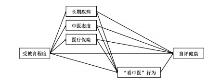
图 1:
本文的研究框架"
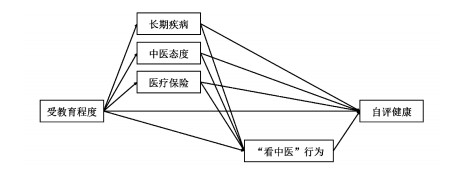

表 1:
变量的描述性统计结果"
| 样本数 | 均值(百分比) | 标准差 | 最小值 | 最大值 | ||
| 因变量 | 自评健康 | 2 285 | 3.48 | 1.08 | 1 | 5 |
| 自变量 | 受教育程度 | 2 285 | 9.42 | 4.65 | 0 | 19 |
| 中介变量 | 看中医 | |||||
| 从不 | 1 130 | 49.45% | ||||
| 很少 | 698 | 30.55% | ||||
| 有时 | 310 | 13.57% | ||||
| 经常 | 133 | 5.82% | ||||
| 非常频繁 | 14 | 0.61% | ||||
| 看西医 | ||||||
| 从不 | 745 | 32.60% | ||||
| 很少 | 773 | 33.83% | ||||
| 有时 | 489 | 21.40% | ||||
| 经常 | 238 | 10.42% | ||||
| 非常频繁 | 40 | 1.75% | ||||
| “看中医”行为 | 2 285 | 3.63 | 1.01 | 0 | 8 | |
| 人口学变量 | 年龄 | 2 285 | 51.74 | 16.98 | 18 | 92 |
| 年龄的平方/100 | 2 285 | 29.66 | 17.40 | 3.24 | 84.64 | |
| 性别 | ||||||
| 女性 | 1 257 | 55.01% | - | - | - | |
| 男性 | 1 028 | 44.99% | - | - | - | |
| 个人维度 | 抽烟 | |||||
| 否 | 1 783 | 78.03% | - | - | - | |
| 是 | 502 | 21.97% | - | - | - | |
| 饮酒 | ||||||
| 否 | 1 702 | 74.49% | - | - | - | |
| 是 | 583 | 25.51% | - | - | - | |
| 体育锻炼 | ||||||
| 否 | 780 | 34.14% | - | - | - | |
| 是 | 1 505 | 65.86% | - | - | - | |
| 收入的对数 | 2 285 | 8.06 | 4.29 | 0 | 16.12 | |
| 家庭维度 | 家庭成员 | 2 285 | 3.43 | 1.82 | 1 | 13 |
| 同住成员 | 2 285 | 2.48 | 1.40 | 1 | 9 | |
| 婚姻状况 | ||||||
| 未婚 | 613 | 26.83% | - | - | - | |
| 已婚 | 1 672 | 73.17% | - | - | - | |
| 社会维度 | 与邻居交往 | 2 285 | 2.70 | 2.24 | 0 | 6 |
| 与朋友交往 | 2 285 | 2.77 | 1.95 | 0 | 6 | |
| 居住地 | ||||||
| 农村 | 970 | 42.45% | - | - | - | |
| 城市 | 1 315 | 57.55% | - | - | - | |
| 居住区域 | ||||||
| 东部 | 981 | 42.93% | - | - | - | |
| 中部 | 689 | 30.15% | - | - | - | |
| 西部 | 615 | 26.91% | - | - | - | |
| 前序中介变量 | 长期疾病 | |||||
| 否 | 1 484 | 64.95% | - | - | - | |
| 是 | 801 | 35.05% | - | - | - | |
| 中医态度 | 2 285 | 3.04 | 0.89 | 1 | 5 | |
| 医疗保险 | ||||||
| 有医疗保险 | 2 188 | 95.75% | ||||
| 无医疗保险 | 97 | 4.25% | ||||
| 工具变量 | 人均传统医药类非物质文化遗产数 | 2 285 | 1.26 | 1.18 | 0.20 | 5.52 |
| 中医相对诊疗比 | 2 285 | 0.15 | 0.05 | 0.11 | 0.26 | |
| 工具变量检验时的控制变量 | 人均中医医疗机构数量 | 2 285 | 0.58 | 0.25 | 0.33 | 1.35 |
| 人均中医医师数量 | 2 285 | 5.80 | 2.57 | 3.85 | 23.14 |
表 2:
ologit基准回归结果 (N = 2 285)"
| 模型1 | |||
| 自评健康 | “看中医”行为 | 自评健康 | |
| 受教育程度 | 0.075*** | 0.042*** | 0.072*** |
| (0.010) | (0.010) | (0.010) | |
| “看中医”行为 | 0.163*** | ||
| (0.040) | |||
| 年龄 | -0.069*** | 0.044** | -0.073*** |
| (0.014) | (0.014) | (0.014) | |
| 年龄的平方/100 | 0.030* | -0.049*** | 0.034* |
| (0.013) | (0.014) | (0.013) | |
| 性别 | 0.146+ | 0.125 | 0.136+ |
| (0.079) | (0.084) | (0.079) | |
| P > chi2 | 0 | 0 | 0 |
| 中介变量的中介效应 | 4.45%** | ||
表 3:
加入作为中介因素的控制变量的ologit回归结果 (N = 2 285)"
| 模型2 | 模型3 | 模型4 | ||||||
| 自评健康 | 自评健康 | 自评健康 | 自评健康 | 自评健康 | 自评健康 | |||
| 受教育程度 | 0.062*** | 0.058*** | 0.062*** | 0.059*** | 0.057*** | 0.054*** | ||
| (0.011) | (0.011) | (0.011) | (0.011) | (0.011) | (0.011) | |||
| “看中医”行为 | 0.163*** | 0.163*** | 0.163*** | |||||
| (0.040) | (0.040) | (0.040) | ||||||
| 年龄 | -0.073*** | -0.076*** | -0.072*** | -0.075*** | -0.072*** | -0.076*** | ||
| (0.014) | (0.014) | (0.015) | (0.015) | (0.015) | (0.015) | |||
| 年龄的平方/100 | 0.034* | 0.038** | 0.033* | 0.037** | 0.034* | 0.037** | ||
| (0.013) | (0.013) | (0.014) | (0.014) | (0.014) | (0.015) | |||
| 性别 | 0.079 | 0.069 | 0.088 | 0.078 | 0.111 | 0.102 | ||
| (0.099) | (0.099) | (0.099) | (0.099) | (0.100) | (0.100) | |||
| 抽烟 | -0.106 | -0.106 | -0.106 | -0.106 | -0.107 | -0.107 | ||
| (0.113) | (0.113) | (0.113) | (0.113) | (0.113) | (0.113) | |||
| 喝酒 | 0.226* | 0.227* | 0.226* | 0.227* | 0.226* | 0.227* | ||
| (0.102) | (0.102) | (0.102) | (0.102) | (0.102) | (0.102) | |||
| 体育锻炼 | 0.222* | 0.221* | 0.222* | 0.221* | 0.221* | 0.221* | ||
| (0.091) | (0.091) | (0.091) | (0.091) | (0.091) | (0.091) | |||
| 收入的对数 | 0.018+ | 0.018+ | 0.018+ | 0.018+ | 0.018+ | 0.018+ | ||
| (0.010) | (0.010) | (0.010) | (0.010) | (0.010) | (0.010) | |||
| 家庭成员 | -0.024 | -0.024 | -0.025 | -0.025 | ||||
| (0.026) | (0.026) | (0.026) | (0.026) | |||||
| 同住成员 | 0.062+ | 0.061+ | 0.062+ | 0.062+ | ||||
| (0.035) | (0.035) | (0.035) | (0.035) | |||||
| 婚姻状况 | -0.031 | -0.031 | -0.031 | -0.032 | ||||
| (0.102) | (0.102) | (0.102) | (0.102) | |||||
| 与邻居交往 | 0.065** | 0.065** | ||||||
| (0.020) | (0.020) | |||||||
| 与朋友交往 | 0.012 | 0.012 | ||||||
| (0.024) | (0.024) | |||||||
| 居住地 | 0.105 | 0.105 | ||||||
| (0.088) | (0.088) | |||||||
| 中部 | 0.054 | 0.054 | ||||||
| (0.096) | (0.096) | |||||||
| 西部 | -0.280** | -0.280** | ||||||
| (0.100) | (0.100) | |||||||
| P > chi2 | 0 | 0 | 0 | 0 | 0 | 0 | ||
| 中介变量的中介效应 | 5.39%** | 5.35%** | 5.84%** | |||||
| 作为中介因素的控制变量的中介效应 | 18.54%*** | -0.63% | 8.81% | |||||
表 4:
加入前序中介变量的ologit回归结果 (N = 2 285)"
| 模型5 | 模型6 | 模型7 | |||||||||
| 自评健康 | “看中医”行为 | 自评健康 | 自评健康 | “看中医”行为 | 自评健康 | 自评健康 | “看中医”行为 | 自评健康 | |||
| 受教育程度 | 0.037*** | 0.036*** | 0.034** | 0.037*** | 0.043*** | 0.034** | 0.038*** | 0.047*** | 0.035** | ||
| (0.011) | (0.010) | (0.011) | (0.011) | (0.010) | (0.011) | (0.011) | (0.011) | (0.011) | |||
| “看中医”行为 | 0.161*** | 0.161*** | 0.161*** | ||||||||
| (0.040) | (0.040) | (0.04) | |||||||||
| 年龄 | -0.064*** | 0.046** | -0.068*** | -0.064*** | 0.041** | -0.067*** | -0.063*** | 0.043** | -0.067*** | ||
| (0.015) | (0.014) | (0.015) | (0.015) | (0.014) | (0.015) | (0.015) | (0.014) | (0.015) | |||
| 年龄的平方/100 | 0.048*** | -0.044** | 0.052*** | 0.048*** | -0.040** | 0.051*** | 0.047** | -0.042** | 0.051*** | ||
| (0.015) | (0.014) | (0.015) | (0.015) | (0.014) | (0.015) | (0.015) | (0.014) | (0.015) | |||
| 性别 | 0.027 | 0.099 | 0.019 | 0.027 | 0.101 | 0.019 | 0.025 | 0.096 | 0.018 | ||
| (0.100) | (0.084) | (0.100) | (0.100) | (0.084) | (0.100) | (0.100) | (0.084) | (0.100) | |||
| 抽烟 | -0.115 | -0.115 | -0.115 | -0.115 | -0.114 | -0.114 | |||||
| (0.113) | (0.113) | (0.113) | (0.113) | (0.113) | (0.113) | ||||||
| 喝酒 | 0.227* | 0.227* | 0.227* | 0.227* | 0.227* | 0.227* | |||||
| (0.102) | (0.102) | (0.102) | (0.102) | (0.102) | (0.102) | ||||||
| 体育锻炼 | 0.227* | 0.227* | 0.227* | 0.227* | 0.227* | 0.226* | |||||
| (0.091) | (0.091) | (0.091) | (0.091) | (0.091) | (0.091) | ||||||
| 收入的对数 | 0.016 | 0.016 | 0.016 | 0.016 | 0.016 | 0.016 | |||||
| (0.010) | (0.010) | (0.010) | (0.010) | (0.010) | (0.010) | ||||||
| 家庭成员 | -0.023 | -0.023 | -0.023 | -0.023 | -0.023 | -0.023 | |||||
| (0.026) | (0.026) | (0.026) | (0.026) | (0.026) | (0.026) | ||||||
| 同住成员 | 0.059+ | 0.059+ | 0.059+ | 0.059+ | 0.059+ | 0.059+ | |||||
| (0.035) | (0.035) | (0.035) | (0.035) | (0.035) | (0.035) | ||||||
| 婚姻状况 | -0.056 | -0.056 | -0.056 | -0.056 | -0.056 | -0.056 | |||||
| (0.102) | (0.102) | (0.102) | (0.102) | (0.102) | (0.102) | ||||||
| 与邻居交往 | 0.064** | 0.065** | 0.064** | 0.065** | 0.064** | 0.065** | |||||
| (0.020) | (0.020) | (0.020) | (0.020) | (0.020) | (0.020) | ||||||
| 与朋友交往 | 0.013 | 0.013 | 0.013 | 0.013 | 0.013 | 0.013 | |||||
| (0.024) | (0.024) | (0.024) | (0.024) | (0.024) | (0.024) | ||||||
| 居住地 | 0.103 | 0.103 | 0.103 | 0.103 | 0.103 | 0.103 | |||||
| (0.088) | (0.088) | (0.088) | (0.088) | (0.088) | (0.088) | ||||||
| 中部 | 0.055 | 0.055 | 0.055 | 0.055 | 0.055 | 0.055 | |||||
| (0.096) | (0.096) | (0.096) | (0.096) | (0.096) | (0.096) | ||||||
| 西部 | -0.283** | -0.283** | -0.283** | -0.283** | -0.283** | -0.283** | |||||
| (0.100) | (0.100) | (0.100) | (0.100) | (0.100) | (0.100) | ||||||
| 长期疾病 | -2.125*** | -0.614*** | -2.077*** | -2.125*** | -0.614*** | -2.077*** | -2.125*** | -0.614*** | -2.077*** | ||
| (0.102) | (0.097) | (0.103) | (0.102) | (0.097) | (0.103) | (0.102) | (0.097) | (0.103) | |||
| 中医态度 | 0.008 | 0.337*** | -0.018 | 0.008 | 0.337*** | -0.018 | |||||
| (0.045) | (0.049) | (0.045) | (0.045) | (0.049) | (0.045) | ||||||
| 医疗保险 | -0.256 | -0.657** | -0.207 | ||||||||
| (0.194) | (0.215) | (0.194) | |||||||||
| P > chi2 | 0 | 0 | 0 | 0 | 0 | 0 | 0 | 0 | 0 | ||
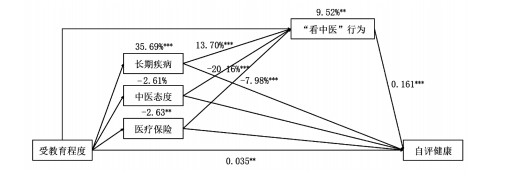
| 中介变量的中介效应 | 7.69%* | 9.18%** | 9.52%** | ||||||||
| 前序中介变量的直接中介效应 | 35.69%*** | -2.61% | -2.63%** | ||||||||
| 分解效应 | 13.70%*** | -20.16%*** | -7.98%*** | ||||||||
表 5:
替换变量后的ologit回归结果 (N = 2 285)"
| 三分类的“看中医”行为 | 自评健康(生理+ 心理) | ||||||
| 自评健康 | “看中医”行为 | 自评健康 | 自评健康 | “看中医”行为 | 自评健康 | ||
| 受教育程度 | 0.038*** | 0.042*** | 0.037*** | 0.021+ | 0.047*** | 0.019+ | |
| (0.011) | (0.011) | (0.011) | (0.011) | (0.011) | (0.011) | ||
| “看中医”行为 | 0.112* | 0.106** | |||||
| (0.050) | (0.041) | ||||||
| 年龄 | -0.063*** | 0.040** | -0.065*** | -0.058*** | 0.043** | -0.060*** | |
| (0.015) | (0.015) | (0.015) | (0.015) | (0.014) | (0.015) | ||
| 年龄的平方/100 | 0.047** | -0.039** | 0.049*** | 0.053*** | -0.042** | 0.055*** | |
| (0.015) | (0.014) | (0.015) | (0.015) | (0.014) | (0.015) | ||
| 性别 | 0.026 | 0.086 | 0.022 | -0.038 | 0.096 | -0.043 | |
| (0.100) | (0.086) | (0.100) | (0.100) | (0.084) | (0.100) | ||
| 抽烟 | -0.108 | -0.108 | 0.013 | 0.013 | |||
| (0.113) | (0.113) | (0.113) | (0.113) | ||||
| 喝酒 | 0.222* | 0.222* | 0.144 | 0.144 | |||
| (0.102) | (0.102) | (0.101) | (0.101) | ||||
| 收入的对数 | 0.233* | 0.233* | 0.098 | 0.098 | |||
| (0.091) | (0.091) | (0.092) | (0.092) | ||||
| 体育锻炼 | 0.016 | 0.016 | 0.028** | 0.028** | |||
| (0.010) | (0.010) | (0.010) | (0.010) | ||||
| 家庭成员 | -0.023 | -0.023 | 0.039 | 0.039 | |||
| (0.026) | (0.026) | (0.027) | (0.027) | ||||
| 同住成员 | 0.059+ | 0.059+ | -0.006 | -0.006 | |||
| (0.035) | (0.035) | (0.035) | (0.035) | ||||
| 婚姻状况 | -0.058 | -0.058 | -0.085 | -0.085 | |||
| (0.102) | (0.102) | (0.102) | (0.102) | ||||
| 与邻居交往 | 0.065** | 0.065** | 0.031 | 0.031 | |||
| (0.020) | (0.020) | (0.020) | (0.020) | ||||
| 与朋友交往 | 0.012 | 0.012 | 0.023 | 0.023 | |||
| (0.024) | (0.024) | (0.025) | (0.025) | ||||
| 居住地 | 0.114 | 0.114 | 0.021 | 0.021 | |||
| (0.088) | (0.088) | (0.088) | (0.088) | ||||
| 中部 | 0.059 | 0.059 | 0.018 | 0.018 | |||
| (0.096) | (0.096) | (0.094) | (0.094) | ||||
| 西部 | -0.273** | -0.273** | -0.279** | -0.279** | |||
| (0.100) | (0.100) | (0.101) | (0.101) | ||||
| 长期疾病 | -2.120*** | -0.493*** | -2.098*** | -1.919*** | -0.614*** | -1.888*** | |
| (0.102) | (0.099) | (0.103) | (0.101) | (0.097) | (0.102) | ||
| 中医态度 | 0.009 | 0.340*** | -0.005 | 0.045 | 0.337*** | 0.028 | |
| (0.045) | (0.050) | (0.045) | (0.045) | (0.049) | (0.046) | ||
| 医疗保险 | -0.259 | -0.736*** | -0.229 | -0.384+ | -0.657** | -0.352+ | |
| (0.193) | (0.223) | (0.194) | (0.197) | (0.215) | (0.197) | ||
| P > chi2 | 0 | 0 | 0 | 0 | 0 | 0 | |
| 中介变量的中介效应 | 4.66%+ | 11.38%* | |||||
| 作为中介因素的控制变量的中介效应 | 个人维度 | 家庭维度 | 社会维度 | 个人维度 | 家庭维度 | 社会维度 | |
| 18.19%*** | -0.61% | 8.88% | 23.01%** | -3.59% | 12.52% | ||
| 前序中介变量的直接中介效应 | 长期疾病 | 中医态度 | 医疗保险 | 长期疾病 | 中医态度 | 医疗保险 | |
| 35.42%*** | -0.17% | -3.01%*** | 51.04%*** | -2.31% | -10.33%*** | ||
| 分解效应 | 13.21%** | -24.15%* | -10.25%*** | 13.70%*** | -20.16%* | -7.98%*** | |
表 6:
内生性检验结果 (N = 2 285)"
| 2SLS | IV-OProbit | KLS | |
| 受教育程度 | -0.003 | -0.003 | 0.018*** |
| (0.012) | (0.009) | (0.005) | |
| “看中医”行为 | 1.020** | 0.829*** | 0.077*** |
| (0.394) | (0.131) | (0.019) | |
| 年龄 | -0.050*** | -0.043*** | -0.028*** |
| (0.014) | (0.009) | (0.007) | |
| 年龄的平方/100 | 0.043** | 0.037*** | 0.020** |
| (0.014) | (0.008) | (0.007) | |
| 性别 | -0.053 | -0.041 | -0.005 |
| (0.071) | (0.056) | (0.047) | |
| 抽烟 | -0.141 | -0.112+ | -0.045 |
| (0.087) | (0.064) | (0.053) | |
| 2SLS | IV-OProbit | KLS | |
| 喝酒 | 0.175* | 0.141* | 0.092+ |
| (0.078) | (0.058) | (0.048) | |
| 体育锻炼 | 0.018 | 0.009 | 0.109** |
| (0.073) | (0.061) | (0.042) | |
| 收入的对数 | 0.009 | 0.007 | 0.009+ |
| (0.007) | (0.006) | (0.005) | |
| 家庭成员 | -0.012 | -0.009 | -0.007 |
| (0.018) | (0.015) | (0.012) | |
| 同住成员 | 0.024 | 0.019 | 0.024 |
| (0.024) | (0.020) | (0.016) | |
| 婚姻状况 | -0.035 | -0.033 | -0.023 |
| (0.069) | (0.057) | (0.047) | |
| 与邻居交往 | 0.025+ | 0.020 | 0.031** |
| (0.014) | (0.013) | (0.010) | |
| 与朋友交往 | 0.002 | 0.002 | 0.003 |
| (0.016) | (0.013) | (0.011) | |
| 居住地 | -0.002 | -0.009 | 0.062 |
| (0.066) | (0.053) | (0.041) | |
| 中部 | -0.076 | -0.059 | -0.013 |
| (0.073) | (0.057) | (0.047) | |
| 西部 | -0.151+ | -0.121+ | -0.100+ |
| (0.082) | (0.066) | (0.055) | |
| 长期疾病 | -0.704*** | -0.542* | -1.001*** |
| (0.139) | (0.235) | (0.043) | |
| 中医态度 | -0.157* | -0.127*** | -0.002 |
| (0.072) | (0.034) | (0.021) | |
| 医疗保险 | 0.236 | 0.190 | -0.078 |
| (0.187) | (0.126) | (0.092) | |
| 人均中医医疗机构数量 | -0.295+ | -0.229* | -0.086 |
| (0.161) | (0.112) | (0.093) | |
| 人均中医医师数量 | -0.041** | -0.033*** | -0.023** |
| (0.013) | (0.009) | (0.008) | |
| P > F / P > chi2 | 0 | 0 | 0 |
图 2:
有序链式中介模型结果"
| 宝音图.2022."上医治未病"之内涵解析[J].医学与哲学(22):65-68. | |
| 郭慧玲.2016.由心至身: 阶层影响身体的社会心理机制[J].社会(2):146-166. | |
| 和鸿鹏、李真真.2018.公众中医就医行为模式研究[J].科学与社会(3):69-80. | |
| 洪岩璧.2015.Logistic模型的系数比较问题及解决策略: 一个综述[J].社会(4):220-241. | |
| 侯金易、李垚锬、王耀献、王珍.2023.基于辨机论治谈对症治疗[J].中医杂志(15):1608-1611. | |
| 黄玉燕、郑齐、汤尔群、张立平、陈曦.2022.2020—2021年度《黄帝内经》研究进展[J].中国中医基础医学杂志(12):1909-1914. | |
| 惠卉、张连城.2023.健康的教育梯度及其影响机制研究[J].人口与经济(3):68-84. | |
| 朗, 丹尼斯. 2001. 权力论[M]. 陆震纶、郑明哲, 译. 北京: 中国社会科学出版社. | |
| 李升、黄造玉.2022.流动人口的居住空间分异与社区健康支持差异[J].中国公共政策评论(2):170-190. | |
| 刘彩、秦洋、陆文静.2021.天津市政策因素对居民中医药服务首诊意愿的影响分析[J].中国卫生统计(4):625-627. | |
| 罗富健、王宋颖、高莉敏.2015.北京社区居民对中医预防保健服务需求的调查与分析[J].北京中医药大学学报(4):284-288. | |
| 罗婧.2023.社会代偿的失灵: 医疗转型中的道义悖论[J].学术月刊(10):125-136. | |
| 吕小康、汪新建.2013.因果判定与躯体化: 精神病学标准化的医学社会学反思[J].社会学研究(3):29-46. | |
| 倪享婷、刘盼、陈奕帆、姚斯怡、徐鑫、邓敏.2020.慢性病老年人健康素养对中医药特色医养需求的影响路径研究[J].卫生经济研究(10):49-53. | |
| 聂伟、风笑天.2015.教育有助于改善身心健康吗?——基于江苏省的数据分析[J].人口与发展(1):50-58. | |
| 彭莹莹、熊巨洋、黎相麟、贾二萍、蒋明珠、沈晓.2019.基于离散选择实验的城市老年慢性病患者医疗服务利用偏好研究[J].中国卫生政策研究(9):54-59. | |
| 彭志毅、王小合、陈小雨、钱宇、潘文文、程港镁、金晨、杨佳琦.2023.我国中医治未病服务政策文本量化分析[J].中国医院管理(3):1-5. | |
| 申漳.2008.中医今解与关系医学[M].北京:社会科学文献出版社. | |
| 孙思邈. 1998. 千金方[M]. 刘清国, 等, 校注. 北京: 北京中医药出版社. | |
| 涂忆桥、李俊林、黄远霞、李毅琳、王磊、张玲、彭丽、钱尼明.2013.武汉市居民健康素养综合评价及影响因素分析[J].中国公共卫生(7):996-998. | |
| 王甫勤.2012.社会经济地位、生活方式与健康不平等[J].社会(2):125-143. | |
| 夏淑洁、陶文娟、邓丽金、陈谦峰、梁永辉、林勇、李灿东.2022.中医诊断的衡与动[J].中华中医药杂志(3):1233-1236. | |
| 顼禹同、苏未、唐颂、马爽.2025.中国居民对中医态度与行为的比较研究: 基于中国综合社会调查2011年和2021年数据的实证分析[J].中国全科医学(23):2915-2923. | |
| 徐兴美、代震、王广通、刘春光、于贞杰、郑文贵、胡善菊、井淇.2023.社会网络分析视角下基层中医药服务发展关键因素探析[J].中国卫生资源(5):556-560. | |
| 闫泽华.2023.沟通时长与医生科技效率认知对医患冲突的交互作用研究[J].社会发展研究(4):84-102. | |
| 姚强、张之恒、程兆辉、李寒旋.2024.医疗保险视角下中国流动人口健康不平等: 理论框架、水平测度与机制分析[J].中国卫生政策研究(11):26-34. | |
| 叶华、石爽.2015.健康的教育梯度、城乡差异与影响机制[J].学术研究(9):50-59. | |
| 尹木子.2016.女性流动人口参加社会保险的影响因素研究[J].大连理工大学学报(社会科学版)(2):94-102. | |
| 印会河.1984.中医基础理论[M].上海:上海科学技术出版社. | |
| 于河、谷晓红、李勋欣、张文静、刘铁钢.2022.名老中医传承要素的多维解析[J].中医杂志(12):1109-1112. | |
| 于晓薇、胡宏伟、吴振华、石静.2010.我国城市居民健康状况及影响因素研究[J].中国人口·资源与环境(2):151-156. | |
| 袁尚华.2015.中医整体观念对疾病整体预防的指导作用[J].中华中医药杂志(7):2313-2315. | |
| 袁尚华.2020.《黄帝内经》治未病辨析新论[J].中华中医药杂志(8):4072-4074. | |
| 赵晶晶、杨秋莉、王子旭.2022.中医望诊中的关注[J].医学与哲学(10):41-44. | |
| 甄橙.2007.病与证的对峙——反思18世纪的医学[M].北京:北京大学出版社. | |
| 周佳梁、赵欢、周令.2017.大连市城乡居民中医养生保健素养调查[J].医学与社会(2):49-51. | |
| Barcellos,Silvia,LeandroCarvalho andPatrickTurley.2018."Education Can Reduce Health Differences Related to Genetic Risk of Obesity: Evidence from a British Reform."Proceedings of the National Academy of Sciences of United States of America115(42):E9765-E9772. | |
| Boccolini, Patricia and Cristiano Boccolini. 2020."Prevalence of Complementary and Alternative Medicine(CAM) Use in Brazil." BMC Complementary Medicine and Therapies 20: 1-10. | |
| Braakmann,Nils.2011."The Causal Relationship between Education, Health and Health Related Behaviour: Evidence from a Natural Experiment in England."Journal of Health Economics30(4):753-763. | |
| Burke,Adam,DawnUpchurch,ClaireDye andLauraChyu.2006."Acupuncture Use in the United States: Findings from the National Health Interview Survey."Journal of Alternative and Complementary Medicine12(7):639-648. | |
| Cutler,David andAdrianaLleras-Muney.2010."Understanding Differences in Health Behaviors by Education."Journal of Health Economics29(1):1-28. | |
| Delaruelle,Katrijin,VeerleBuffel andPietBracke.2015."Educational Expansion and the Education Gradient in Health: A Hierarchical Age-Period-Cohort Analysis."Social Science & Medicine145:79-88. | |
| Gonzalez,Jodi,MargaritaAlegria,ThomasPrihoda,LaurelCopeland andJohnZeber.2011."How the Relationship of Attitudes toward Mental Health Treatment and Service Use Differs by Age, Gender, Ethnicity/Race and Education."Social Psychiatry and Psychiatric Epidemiology46(1):45-57. | |
| Idler,Ellen andYaelBenyamini.1997."Self-Rated Health and Mortality: A Review of 27 Community Studies."Journal of Health and Social Behavior38(1):21-37. | |
| Johnson,Wendy,KirstenKyvik,ErikMortensen,AxelSkytthe,DavidBatty andLanDeary.2010."Education Reduces the Effects of Genetic Susceptibilities to Poor Physical Health."International Journal of Epidemiology39(2):406-414. | |
| Karlson,Kristian,AndersHolm andRichardBreen.2012."Comparing Regression Coefficients between Models Using Logit and Probit: A New Method."Sociological Methodology42(1):286-313. | |
| Kawachi,Ichiro andLisaBerkman.2001."Social Ties and Mental Health."Journal of Urban Health: Bulletin of the New York Academy of Medicine78(3):458-467. | |
| Kiviet,Jan.2020."Testing the Impossible: Identifying Exclusion Restrictions."Journal of Econometrics218(2):294-316. | |
| Kiviet,Jan.2023."Instrument-Free Inference under Confined Regressor Endogeneity and Mild Regularity."Econometrics and Statistics25:1-22. | |
| Kwon,Mihyoung andJihyunOh.2021."Mediating Effects of Family Stress on the Relationship between Self-Efficacy and Midlife Crisis in Middle-Aged Men."Sustainability13(7):3761. | |
| Lynch,Jamie andvon HippelPaul.2016."An Education Gradient in Health, a Health Gradient in Education, or a Confounded Gradient in Both?."Social Science & Medicine154:18-28. | |
| Lynch,Scott.2003."Cohort and Life-Course Patterns in the Relationship between Education and Health: A Hierarchical Approach."Demography40(2):309-331. | |
| Mirowsky, John and Cathrine Ross. 2003. Education, Social Status, and Health. New York: Aldine Transaction. | |
| Montez,Jennifer,MarkHayward,DustinBrown andRobertHummer.2009."Why is the Educational Gradient of Mortality Steeper for Man?."Journals of Gerontology Series B: Psychological Sciences and Social Sciences64(5):625-634. | |
| Pathirana,Thanya andCarolinaJackson.2018."Socioeconomic Status and Multimorbidity: A Systematic Review and Meta-Analysis."Australian and New Zealand Journal of Public Health42(2):186-194. | |
| Ross,Catherine andWuChia-ling.1995."The Links between Education and Health."American Sociological Review60(5):719-745. | |
| Winkleby,Marilyn,DariusJatulis,EricaFrank andStephenFortmann.1992."Socioeconomic Status and Health: How Education, Income and Occupation Contribute to Risk Factors for Cardiovascular Disease."American Journal of Public Health82(6):816-820. | |
| Winship,Christopher andRobertMare.1984."Regression Models with Ordinal Variables."American Sociological Review49(4):512-525. | |
| Zimmer,Zachary andVipanPrachuabmoh.2012."Comparing the Socioeconomic Status-Health Gradient among Adults 50 and Older across Rural and Urban Areas of Thailand in 1994 and 2007."Social Science & Medicine74(12):1921-1928. |
| [1] | 洪岩璧, 赵延东. 灾后重建中的资源再分配与健康不平等:基于三期汶川地震重建调查[J]. 社会杂志, 2019, 39(6): 214-237. |
| [2] | 周彬 | 齐亚强. 收入不平等与个体健康——基于2005年中国综合社会调查的实证分析[J]. 社会杂志, 2012, 32(5): 130-150. |
| 阅读次数 | ||||||
|
全文 |
|
|||||
|
摘要 |
|
|||||
